JWTroemner.com

Home of JW Troemner and Urban Dragon

  • According to Wikipedia, an archetype is defined as:

    1. A statement, or pattern of behavior, a prototype upon which others are copied, patterned, or emulated.
    2. The Platonic philosophical idea, referring to pure forms which embody the fundamental characteristics of a thing.
    3. In Jungian psychology, archetypes refer to a collectively inherited unconscious idea, pattern of thought, image, etc., universally present in individual psyches.
    4. Archetypes can refer to a constantly recurring symbol or motif in literature, painting or mythology. This usage of the term draws from both comparative anthropology and Jungian archetypal theory.

    In literature, The Mentor is an archetype (Gandalf, Obi Wan Kenobi, Dumlbedore, Giles from Buffy The Vampire Slayer, and so forth). So is the Everyman (Arthur Dent, Bilbo Baggins, John Watson… basically every character Martin Freeman has ever played). You can find twelve examples of them here— or spend the next two weeks of your life lost in the digital labyrinth that is TV Tropes. But while some archetypes are universal, every writer has a couple of tropes that are their personal favorites.

    So here are two (three?) of mine:

    Source: Wikipedia http://en.wikipedia.org/wiki/File:Tiger_in_South_India.jpg
    Source: Wikipedia http://en.wikipedia.org/wiki/File:Tiger_in_South_India.jpg

    The Pet Tiger

    I began noticing these sorts of characters as a teenager. Izark/Izaac in From Far Away/Kanata Kara.  Vegeeta in Dragon Ball Z (to some degree). Sesshomaru in Inuyasha. Yes, I watched a lot of anime during that time of my life. Recently, I would refer to Spike from Buffy the Vampire Slayer and Castiel from Supernatural as Pet Tigers, as is Booker DeWitt in Bioshock Infinite... though he’s got the less common designation of being an anti-hero to start out with, rather than an outright villain.

    The pet tiger is a person who is powerful– often insanely so, to the degree that they first appear as a small-scale villain. They’re big, they’re scary, they could snap you like a toothpick. But then they have one too many run-ins with the wrong person (TV Tropes refers to this person as a Morality Pet). They’re forced into prolonged exposure to that person, for some reason can’t kill them, and they start to appreciate them– as a friend, as a potential lover, as somebody to protect, it doesn’t matter. Somehow, usually completely by accident, they wind up tamed. They still growl, but they don’t bite nearly as often– unless somebody hurts the Tiger’s Morality Pet. At that point, there is no force on Hell or earth that can save you from their wrath.

    In my writing, Pet Tigers tend to be associated with cats or dogs– predators that in their larger forms famously eat people, but which we keep as loving pets.

    Yin_and_Yang.svgJara and Kya

    If the name Kya is familiar, this is why. Once upon a time, my best friend and I started working on a story together. The two main characters were originally based on ourselves– and then stylized and exaggerated so many times so as to become something else entirely. My character’s name was Jara, hers was Kya.

    The Kya is bright and bubbly, trusting and naiive– not because she’s stupid, but because she can afford to be. She’s nice to everyone and give them the benefit of the doubt, because if they betray that trust, she knows the Jara will royally mess them up. In comparison, the Jara is quiet, and usually only opens her mouth to be snide, snarky, or strategic. She naturally assumes the worst of others, and is ready with contingency plans for anything that could possibly go wrong. Usually violent ones. Often the Jara tries to experience joy vicariously through the Kya, usually by spoiling her rotten and letting her have her way, and tends to express anger on both of their behalf, so the Kya doesn’t have to deal with the consequences of such an outburst. They tend to be at least slightly codependent on one another, and stories tend to grind to a halt when they’re separated: the Jara is too practical to do anything adventure-worthy of her own volition (better to bunker down and fortify), and the Kya too whimsical and optimistic to stay alive very long without somebody to watch her back.

    Will and Jem of The Infernal Devices are essentially poster children for the archetype. Supernatural‘s Sam and Dean sometimes reflect the Jara/Kya dynamic, but not nearly as much as do Flynn and Rapunzel from Tangled. Kyouya and Tamaki of Ouran High School Host Club also fit the mold to a degree.

    I put a Jara/Kya pair in every work, even if they’re very minor characters. They’re easy enough to find: When I write them, the Jara of the pair always has ‘ara’ somewhere in her name. I like to think of it as a personal signature, not unlike the way Terry Pratchett always has Death make a cameo in the Discworld novels, even if he’s not part of the main plot line.

    Admittedly, Pet Tigers and Jara/Kya pairs aren’t that far apart. A Jara could well be a Pet Tiger who’s had several years of practice. Generally Jara/Kya pairs have a longstanding history and tend to act as a unit rather than individually, while the Pet Tiger is more often seen grumbling alone in a corner until he’s needed.

    Sensing a pattern here…?

    I’m not shy about admitting that I’ve always had a thing for devotion that borders on the obsessive. Miss Pross is my favorite character from A Tale of Two Cities, as are Samwise Gamgee from The Lord of the Rings and Conseil from 20,000 Leagues Under the Sea… and Lindy is eternally tied with Maladonis Bin for my favorite character in Kindar’s Cure. These are the kind of characters I like to read about, and therefore they keep winding up my writing.

    Do you have any personal tropes or archetypes you go out of your way to include– or ones that keep cropping up in your writing by accident? Tell us about them in the comments!

  • Heroine

    The other night I was reading meta analysis on season seven of Supernatural (because that’s what good little grad students do instead of their homework), when I learned something entirely new. The analyzer kept referencing the Heroine’s Journey– and honestly, my eyes glazed right past it. After all, this was on Tumblr, which has a stronger feminist slant than much of the internet. I wrongly assumed that this was just a personal way of evening the linguistic playing field, much the same way many writers will alternate ‘he’ and ‘she’ as universal, gender-neutral pronouns.

    Finally I gave up and clicked one of the links to a different analysis, What I learned shocked me: the blogger FlutieBear wasn’t referring to the Hero’s Journey with which I was familiar, but to something else entirely.

    If you aren’t familiar with the Heroine’s Journey, I recommend reading FlutieBear’s analysis. She’s far more familiar with it than I am.  I’ll be going in a slightly different direction with this post. You’ll find a similar (but shorter) analysis here.

    (Note: there are a lot of maps and Journeys referred to as the Heroine’s Journey, dealing with everything from separating and unifying the masculine and feminine to a woman’s coming to terms with her sexuality, etc. I have yet to research them all, and therefore I’m referring to the ones I specifically linked to, not others. As I said, I learned about this less than a week ago.)

    English: This image outlines the basic path of...
    This image outlines the basic path of the monomyth, or “Hero’s Journey”.  (Photo credit: Wikipedia)

    My History with my Hero

    For background, the Hero’s Journey is what’s known as the “Monomyth”– it’s a nearly universal story structure identified and codified by Joseph Campbell in The Hero with a Thousand Faces, an analysis on mythology and, in turn, fiction, written in 1949. The argument is that nearly every story maps almost perfectly to this narrative pattern (a call to action, heeding the call, meeting the mentor, etc).

    I first learned of this structure in the sixth grade, and it was repeated to me at least once per year ever since. Not a single literature or creative writing class skipped on the Hero’s Journey, to the point where I could recite it in my sleep. In fact, almost every single one of my teachers and professors (I majored in English during my Undergrad) claimed that this was the only correct narrative structure– some even went as far as to say that a story was lacking or wrong if it didn’t adhere to The Hero’s Journey perfectly (or else that the analyzer was simply misinterpreting the text). That last bit has a nasty way of getting under your skin if you’re a writer whose story doesn’t perfectly map to Campbell’s Monomyth.

    Now I’m twenty-four, I’ve taken an honest decade’s worth of writing classes, and only just now discovered that the Monomyth isn’t quite as universal as advertised.

    Side by Side

    Enter The Heroine’s Journey, by Maureen Murdock (written in 1990, by the way– newer than Campbell, but still nearly as old as I am). It’s very similar to the Hero’s Journey, but not quite the same– meaning it’s easy to see a Heroine story and try to hammer it into the Hero archetype. While explaining this new discovery to my husband, he asked me to explain how it differentiated from the structure he was used to. So here’s my (admittedly rudimentary) understanding of some of the big differences:

    From the get-go, the Hero’s Journey starts with The Call To Action… and then Refuses The Call. After all, Luke Skywalker can totally keep going as a moisture farmer. Frodo Baggins can totally keep chilling in the Shire. Then something happens to push our Hero out of his nest and forces him to Cross the Threshold.

    The Heroine doesn’t quite get that option. Though she was probably decently happy before then, she relied on a crutch or a coping mechanism to keep her happy. For whatever reason, that crutch fails. The coping mechanism isn’t going to cut it anymore. She departs from her life because staying the same is no longer an option.

    Therefore, while the Hero is often thrown into the wild with nothing but a Mentor to cover his ass, the Heroine usually has a time to stock her proverbial utility belt with tools and supplies to get her through.

    The Hero then progressively picks up things over the course of his trials– a magic sword, some superpowers, what have you– with every little victory he wins along the way. Meanwhile, the Heroine’s tools fail her, or are lost. Her mental and emotional crutches are knocked out from under her.  While the Hero is built up through repeated victory, the Heroine is stripped bare by repeated defeat. It’s painful as hell, but it isn’t a bad thing. Every one of those near-failings, those moments where she scrapes past by the skin of her teeth, burns away her weaknesses and shortcomings until only strength remains.

    While the Hero’s Journey tends to make other characters into sidekicks (like The Mentor, doomed to die when he stops being useful), the Heroine’s friends are considered among her new strengths, and are essential to overcoming Death (her equivalent to the Hero’s Blackest Hour or Crisis). When the Hero finishes his Journey, he’s often the Very Best– the King, the Jedi Master, etc. Honestly, there’s often not much room for improvement on what he’s already accomplished. Meanwhile the Heroine still has room to grow when her Journey ends. Her strengths may be honed for one Journey, but she may still have weaknesses or flaws that will still need refining in the future. Hers is a character who doesn’t have to stop growing and changing just because the villain is defeated.

    Not Quite Exclusive

    Still in the car with Boxy, we tried to sort his favorite movies into Heroes and Heroines. Surprisingly, most of his favorite female protagonists (like Alice in the Resident Evil movies and Honor Harrington of her self-titled series) wound up mapping closer to Heroes, while Mission Impossible: Ghost Protocol and Supernatural had more Heroine plots. I’ve spoken before on “Masculine” and “Feminine” plots— which refers to a style of advancing the story, rather than its appeal to a particular gender or a need to feature men or women as protagonists. However, there is a tendency to build upon traditional “feminine” virtues– teamwork, introspection, emotional intelligence, etc, as opposed to raw power and shows of strength.

  • Meandering through the internet, I found a pair of images that really struck me. I’ll let them speak for themselves:

    1009850_322914131185367_990652507_n
    Source: https://www.facebook.com/TheBestOfTumblrV2 – Originally found on Tumblr
    monster
    “It was finally destroyed with a nuclear weapon carrying the destructive energy of the Hiroshima bomb.”
    Source: XKCD – http://xkcd.com/1257/

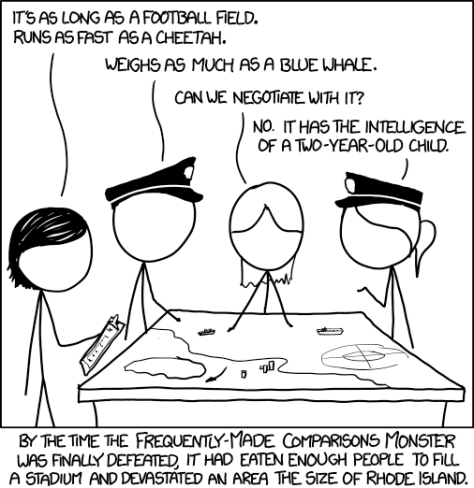
    The difference between the first and the second is staggering. One is vivid and evocative, the other is silly– and makes a striking point. These comparisons are so overused (so cliche) that they have ceased to actually mean anything. Essentially the comic can be rewritten: “It’s big, it’s fast, it’s heavy, and it’s stupid… it ate a bunch of people, and caused lots of destruction.” And this is why we encourage people to stay away from cliches: because they’re generally just a very long way of saying something very simple, without adding any meaning or context.

    On the other hand, the description of red is vivid. The color’s association with passion and rage maybe often used, but in this case it becomes personal, because it’s directly tied into the story that’s being told.

  • You may have noticed that I’ve dropped off the face of the earth since the end of my July blogging challenge.

    I’ve been tremendously busy lately, and this little guy is most of the reason behind it. We brought him home on August 4, and he’s a real handful!


  • Art installation in the Indianapolis Marion County Public Library

    Art captured in words won’t hide in shadow. It emerges to illuminate life.

  • The Scenario

    A while back I was working on a story with Kya, and I kept hitting a roadblock with one character in particular. She was an ordinary teenager tossed into a magical world. Unfortunately, she was also more grounded than she was practical. Looking at the magic, she started coming up with every possible explanation: that she’d been dosed with something and was hallucinating, or that she was dreaming.

    No matter what she witnessed, nothing could disprove the idea that none of this was real. Now, this was a problem, because she was in a desperate situation… but wouldn’t necessarily react to it with desperation, because she firmly believed that it wasn’t real.

    René Descartes (1596-1650)
    René Descartes (1596-1650) (Photo credit: Wikipedia)

    The Philosophy

    In the same way, absolutely nothing could possibly disprove the notion that you’re in the Matrix right now, aside from blind faith that The Matrix is just a movie. After all, any evidence we have could have been fabricated.

    One of the first people who considered this idea (at least, the first who bothered writing it down) was a philosopher named René Descartes. He pointed out that everything he learned could be a lie, or a dream, or the influence of a “wicked demon” bent on tricking him.

    Bringing a character down the rabbit hole

    As far back as Through the Looking Glass, characters have been stepping out of the ordinary into worlds beyond their imagination. Part of the drama there is figuring out how they come to terms with that, if they do at all. For example:

    • In Inception (as well as an episode of Doctor Who), the only way of escaping the deepest levels of the dream world is to die. So how do you know if you’re about to wake up, or just about to off yourself for real?
    • If you’re in a dream, then the other people in the dream are merely figments of your imagination. Therefore, does it matter if they get hurt? On the other hand, should you let yourself get attached to somebody who will disappear when you wake up?
    • If the “dreamer” believes they’re asleep, does somebody else take care of them? How does that interaction play out?
    • Does the “dreamer” ever come to grips with this new reality? What makes them come to that conclusion?

    There are countless ways of playing out this scenario, ranging anywhere from the philosophical to the purely practical.

    What about you? Have you seen any works where a character has decided to check out and refused to acknowledge reality? How do you deal with a character in this sort of situation? Let us know in the comments!
  • Keeping on track

    If there’s one thing that far too many of us have in common these days, it’s the simple words: “I am busy”.

    At the moment I’m going to school to pursue a Masters of Library Science, I’m running a freelance editing service, I’m trying to fix up my own manuscript, I’m participating in the Speculative Fiction Critiquing Marathon on Agent Query Connect, I’m trying to keep on top of the cooking and cleaning and yard work…

    My pumpkin patch is currently trying to declare its independence
    My pumpkin patch is currently trying to declare its independence

    And in a few days, I’ll be caring for and training our brand new puppy. (Yes, I’ll post pictures when I bring him in.)

    These days, it feels like my catchphrase is “Give me one second!” as I’m scrambling to get everything done.

    People are going to give you a billion tips and strategies for ways to streamline your life and make things more manageable. There are thousands of options and methods out there.

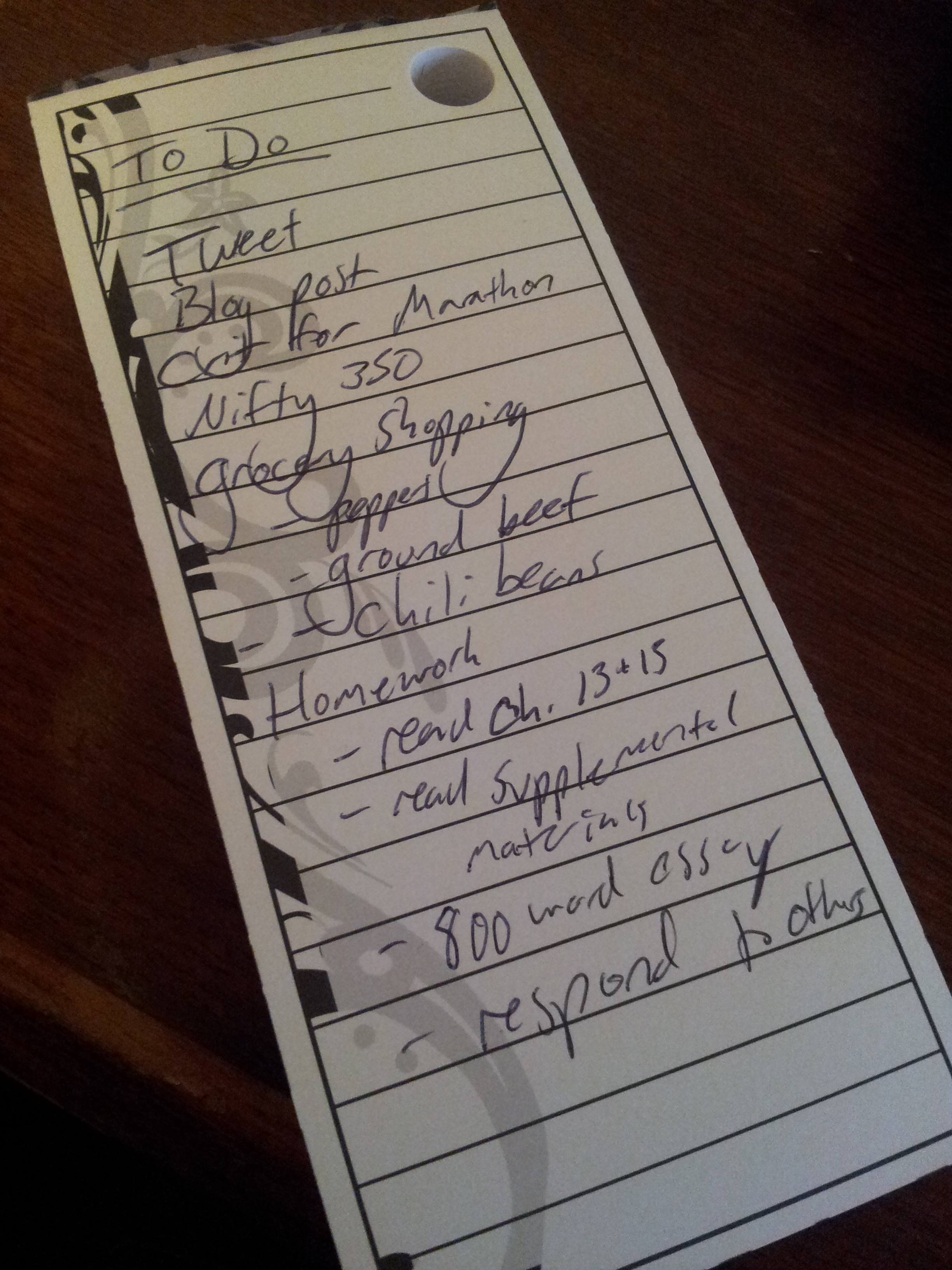
    Me, though, I like keeping a list.20130731_224615

    I like to consider myself a master procrastinator. If something’s making me anxious, then I’ll put off doing it until the last minute. That’s what makes a simple pen-and-paper to-do list so effective for me: usually, I don’t have to do the tasks in any particular order.

    If I don’t want to do my homework, I can jump to something else on the list. I can procrastinate all I want with less intimidating tasks, and still feel like I’m being productive. Often, by the time I’ve gotten a bunch of other stuff done, I feel confident enough to tackle the scarier projects.

    When the project is particularly big, I can divide it into smaller tasks, each of which I can check off when I get done with it. After all, there’s a feeling of satisfaction that comes when you cross an item off, even if it’s a small one.

    If you like technology, here are some free digital to-do lists that I’ve found:

    • Subtask divides larger projects up into smaller tasks and tells you how far along you are as you check things off
    • Remember the Milk is a to-do list app that can connect to your phone and computer, and it can send you reminders via text and Skype messages
    • Astrid was an awesome program, but it has since shut down.
    • ToDo.ly — I haven’t tried this one yet… but I’m sure I’ll get around to it…
    • To Do (Tomorrow) advertises itself as a To-Do list for procrastinators. It’s Apple-based, but has options for Android as well.

    Do to-do lists work for you? Why or why not? And do you have any software that you’re especially fond of for keeping productive? 

  • While I’m busy with grad school, I’ll be replaying some of the most-read posts from my old blog.

    Some people instantly gravitate to one particular narrative style. The story they’re writing just naturally lends itself to one Point of View (POV) in particular. After all, who would want to read “That guy over there? His name is Jake,” as the intro to one of the Animorphs books? The same goes with Terry Pratchett’s stories– they just don’t work if you were to squeeze the whole story into a single person’s head.

    Other stories, though, get a bit fuzzier, and we writers can get iffy on what POV works best for what stories. Hopefully, though, I can clear up a bit of that fuzziness. 

    Third Person

    This is the standard fairy tale narrator. It’s an all-knowing, all-seeing, omniscient being that intimately knows the thoughts, feelings and intentions of everything. The Third Person uses words like ‘he’ and ‘she’ and ‘it’ and ‘they’, rather than ‘I’, ‘you’, ‘us’ and ‘we’. As with the First Person, a lot of its pros are cons, and vice versa. (more…)

  • marilyn
    Marilyn’s traditional poses are given a whole new perspective. (Photo credit: bionicteaching)

    I’ve heard a lot of people say gender doesn’t matter– that we are all equal in soul and under the skin– and I’m not arguing that, with or against. But it’s undeniable that society changes our expectations of how men and women look, think and behave, and how they should be portrayed– at least on some level. The Hawkeye Initiative plays with this concept a lot, pointing out that what we consider acceptable poses for female comic book characters are just plain ridiculous when you make a male character try to pull them off.

    Even in my own writing, gender plays a big role in how my characters behave. My first finished manuscript began as an idea for a character, but without a sex to go with it. After consulting with my little sister, I decided the name was more feminine than masculine, and the rest of the story fell into place. I can guarantee that it wouldn’t be the same story if Chicago was a teenage boy being stalked by his childhood maybe-girlfriend. In another manuscript, I’ve got a very powerful and confident woman… who, when genderflipped, stops seeming powerful and starts looking like a sexual predator.

    ZurJagdSaison

    I’m not saying all traditional gender-based behaviors and actions are necessarily bad, but they do open the doors for us to gain some new perspective.

    If you’re having trouble writing a scene, try flipping it– all the dudes are now chicks, all the chicks are now dudes, all the MtF are now FtM, etc– and write it from that perspective. What are they saying that they weren’t saying before? What are they suddenly hiding? Pay attention to the changes in their body language, changes in vocabulary.

    Once you’ve written it gender-bent, go back and turn it right-side-up (or maybe you’ll find it works better that way, and change the rest of the story to match it). If you decide to keep your initial gender roles, rewrite that scene back in the old style, but still pay attention to the body language, the vocabulary, the taboos and secrets and posturing. You’ll be amazed what you find.

  • “It does not do to dwell in dreams and forget to live.”

    –Albus Dumbledore, Harry Potter and the Sorcerer’s Stone

    It’s been a rough summer for me. I recently started grad school, and between that, blogging, and the annual Spec Fic Marathon, I’ve ended up getting cloistered inside my office. I’ve gone weeks without seeing anybody besides my husband, and rarely left the house for anything but food and grocery shopping. Sometimes, Boxy got hit hard by work assignments, I’d go a couple of days without seeing him for more than a few minutes, too.

    This isn’t healthy.

    No matter what your venture, be it writing, school, starting a small business, what have you, isolation isn’t good for it. No matter how much you study theories and abstractions, there is so much to be learned and gained from simply going out and living life. Every time we interact with another human being, we’re picking up new variables, new insights, new perspectives.

    And over the last month and a half, I’ve been neglecting to pick those up.

    I’ll still be blogging daily until the end of July, but after that point I’ll be slowing down.