Tag: The Process of Writing


  • So here’s a question: why are animals called what they are?

    I’m not talking about the big categorical names– things like ‘dog’ and ‘cat’ and ‘horse’ go back for hundreds of years, according to etymology. But when you want to get more specific than that, things get a little wonky. 

    Let’s talk fossils and dinosaurs: if you’re thinking about the long-necked behemoth, LittleFoot from Don Bluth fame, you’re probably thinking about a brontosaurus– except, as pedants in any natural history museum used to be quick to tell you, brontosaurus didn’t actually exist.

    Photo by Magda Ehlers on Pexels.com

    According to an article by Emily Osterloff on the Natural History Museum website,

    “The first recorded evidence of Brontosaurus was discovered in the 1870s in the USA. But by the early 1900s, scientists had started to question whether the fossils used to name Brontosaurus actually came from another dinosaur, the remarkably similar Apatosaurus

    Due to the rules of scientific naming – the first name published gets priority – Brontosaurus was relegated to scientific history and the fossils reassigned to Apatosaurus.”

    But remember that I said pedants used to be big on this subject? Turns out, even fossilized facts are subject to change. Osterloff continues:

    “That was until a study in 2015 unexpectedly found evidence that Brontosaurus was distinct from Apatosaurus all along, signaling the reinstated status of this iconic dinosaur.”

    This plays on an established rule in the paleontological world: the earliest name for the fossil is what gets to stay. And that’s all well and good for creatures whose existence predates humans by eons. 

    What about the ones that are living side-by-side with humans?

    Here’s where things get political again, particularly when we talk about species native to colonized places.

    The thing about colonizers is that they tend to suddenly come into contact with a lot of unfamiliar things. Sometimes they’ll ask the indigenous peoples of the area what the heck those weird-looking animals are called (where we get words like condor, kangaroo, and koala, from  Quechua, Guugu Yimidhirr, and Dharug, respectively). Other times, they’ll either neglect to ask the name or ignore it altogether, and instead refer to it as something similar they remember from home, as is the case with robins. According to Kenn Kaufman at Audobon.org:

    “When English-speaking explorers and colonists began traveling the world, they applied the name Robin to anything that reminded them of the familiar bird from home. Our American Robin really isn’t similar, aside from having orange on the chest; it’s twice the size and four times the bulk of the European bird, and these days it isn’t even classified in the same family. Neither are the Australasian robins (family Petroicidae), more than 50 species of small, sharply patterned birds found from New Guinea to Australia and New Zealand. Various robin-chats in Africa and robins in Asia are at least placed in the same family as the European Robin, but they’re not all closely related. But none of that really matters; it’s a good name, and we can sort out any possible confusion by looking at the scientific names.”

    And other times entirely, the species they come across are named to honor someone and something. And as with place names, the choice of who gets honored by that kind of name can be fraught.

    Take for example the ʻaoʻū, previously called the Christmas shearwater, a bird native to the shores of Hawai’i– the defunct name seems rather bizarre, considering that Christmas was a tradition that was completely nonexistent in Hawaii before the late 1700s. Meanwhile the current name ties into the language and traditions of the Hawaiian people, and is itself descriptive: According to a press release from the Office of Hawaiian Affairs, “The name ʻaoʻū was chosen for the Christmas shearwater based its call, where the sound ʻao is repeated six times followed by a long ʻū sound. “ʻAo” means a new shoot, leaf, or bud, especially of taro, and “ao” also refers to clouds, the light of day or daylight as well as enlightened; to regain consciousness. ʻŪ means to growl, grunt, groan, moan, sigh, hum, coo; to hold the breath. Naming birds from their sound is a common practice for many sea and shorebirds in Hawaiʻi.”

    Another push toward decolonizing birds in particular has come in the wake of a highly publicized 2020 incident involving birdwatcher Christian Cooper, which sparked conversations about racial bias and its intersection with the (stereotypically very white) field of birdwatching– and in this case, how discouraging it can be for birdwatchers of color such as Cooper to realize just how many of the birds they love are named for slaveholders and white supremacists. 

    The Ad Hoc Committee on English Bird Names for the American Ornithologists’ Union is opting to move on from person-based naming conventions entirely and move toward more intuitive and descriptive names. “They imply possession of a species,” explained committee co-chair Erica Nol, who went on to point out the intrinsic bias within those names that are given: “They are overwhelmingly from a particular time and social fabric, they are almost all White men, few women, and women were almost all first names.” 

    There’s some pushback, of course– like with places, there are a lot of people pointing to history, and to habit, and to the inconvenience of renaming these creatures. 

    But in the end, what we call a thing is a choice, and what choice we make speaks volumes about what we value.


    This is the third installment of a four-part series on choosing names and why they matter.
    Part 1: A Person by Any Other Name
    Part 2: Politics of Place
    Part 3: A Take on Taxonomy
    Part 4: Imaginary Worlds

  • I’ve been doing a lot of pondering about names. How they change, how they represent us, where they come from and why.

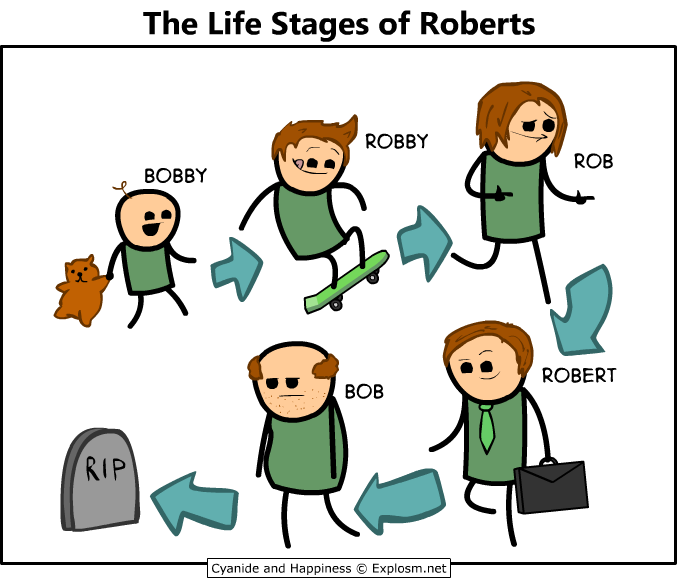
    Cyanide and Happiness has a great comic titled The Life Stages of Roberts, about how a single name carries completely different associations and how that can change throughout a person’s life. 

    People in the LGBT+ community are well acquainted with the way people can be uplifted or protected or harmed by the names others choose to use for us. For a well-known literary example, I like to point at the protagonist of Victor Hugo’s Les Miserables, a man of many names: 

    • he was born Jean Valjean, a family name shared by a really delightful number of his relatives

    • Upon being imprisoned in the bagne, he was designated Prisoner 24601, meant to rob him of his personhood 

    • But the other prisoners called him Jean le Cric, or Jean the Jackscrew, because his impressive strength

    • In Montreuil-sur-Mer, he constructed a new name and identity as Father Madeline (itself a reference to Mary Magdalene, and all the Biblical allusions that entails), in an attempt to escape the crushing stigma of being an ex-convict

    • Then when he was re-arrested and given a new designation: Prisoner 9430 (which, alas, doesn’t go to music nearly as well as his more famous number)

    • Upon his escape he takes shelter with a friend from his past and assumes the identity of the friend’s brother: Ultime Fauchelevant, which provides him safety

    • Except when he’s held hostage and made to send a note under duress by villains who only know the initials of his assumed name, so he signs it Urbain Fabre 

    • While at Paris he’s also sneaking around anonymously giving out gobs of money to the poor while dressed in rags, earning himself the name The Beggar Who Gives Alms, while also using the name Leblanc as an alias

    • At this point he’s also adopted a daughter, who calls him Papa— until he makes the choice to distance himself from her for her protection, and insists that she only refer to him as Monsieur Jean 

    Each of those names carries vastly different contexts and meanings. Some of them signify respect, some derision, some are shields to protect him from scrutiny, some are weapons used to hurt him. And that’s just a single character in a single book.

    This is the first part of a four-part series on choosing names and why they matter.
    Part 1: A Person by Any Other Name
    Part 2: Politics of Place
    Part 3: A Take on Taxonomy
    Part 4: Imaginary Worlds

  • On the Map

    I’m one of those proud nerds who loves looking at a map when I open a book. So when I created the world of Koleth, of course I wanted to include maps.

    Koleth was built from below the ground up– by which I mean, I started with plate tectonics on a globe and worked my way up. Which is how I got this delightfully messy world map over here:

    From there I added some national divisions, etc:

    (Ignore the massive poles– map projections can be tricky that way).

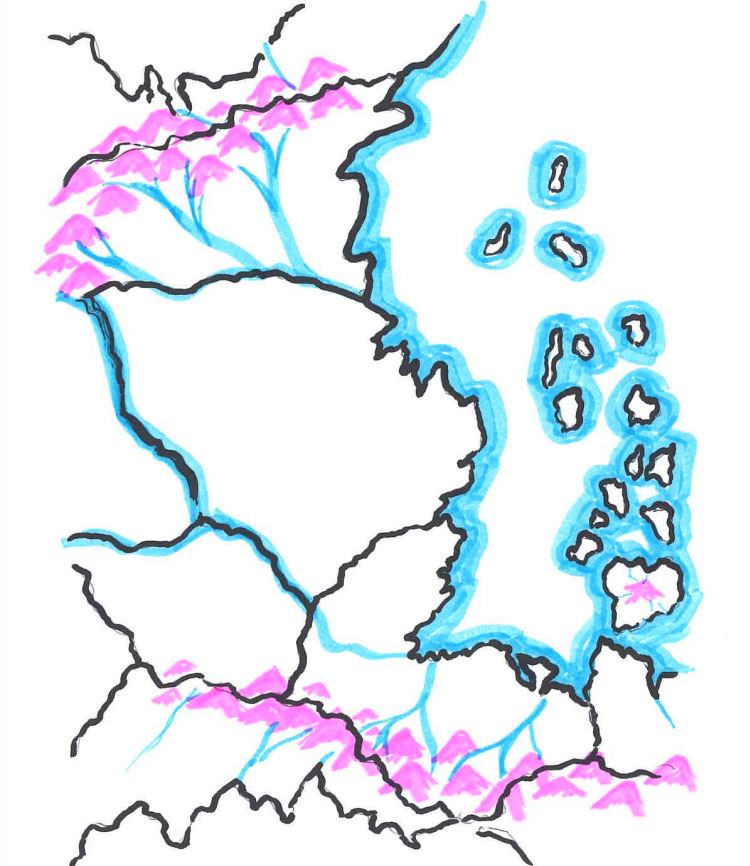
    But all that’s way too much information to include on a map for this one story. So I zoomed in a bit, lightened it enough so I wouldn’t murder my printer, and added the locations I mention in the Dealmaker’s Gambit.

    And then traced over that with a good old sharpie and some highlighters (it was a slow day at work.)

    After that it was a matter of cleaning it up in photoshop, adding some text, and voila!

    That looks like something that you might find in a book!

  • I’ve talked a little bit about the research that goes into writing fantasy stories. Even if the world you’re writing in is not at all the one we live in, I tend to think it’s safe to pull at least a little bit from our world’s history.

    Would people with this technology level in that climate be wearing these fashions? Can these crops be grown on a large scale in that environment? Would those weapons still be used if that technology is available?

    For me, I try to anchor my setting to a rough analogue of a specific time and place, because that makes research a whole lot easier. For example: I’m anchoring my current story to Europe in the mid-1800s, so it’s safe to assume that the same factory setup that is manufacturing, say, guns, is also manufacturing clothing. Because factory-produced cloth is going to be cheaper and have different qualities than homespun clothes, certain fashions are going to change– also, factory workers won’t be able to wear certain clothes that could potentially get caught in the machines, etc.

    Without the influence of a major change like aliens or grand-scale magic, it’s safe to assume that certain shifts in things like food, fashion, etc, can move predictably over the years.

    And then something happens that throws a wrench in the works.

    Like a Mr. Beau Brummell.

    English dandy George Bryan Brummell (1778 -1840), known as Beau Brummell. (Photo by Hulton Archive/Getty Images)

    Before he marched onto the scene, men’s* fashion changed frequently, often matching the gradual changes in style, fabric, and sillhouettes you you see in women’s fashion of the same time. Shortly before him, one of the big hip things was for men to wear tight hoes and knee-length breeches so they could show off their saucy, sexy calves, matched with long coats that could just about count as a gown in their own right.

    A 1793 contrast between French fashions of 1793 (left) and ca. 1778, showing the large style changes which had occurred in just 15 years. Source: Wikimedia Commons
    At this time, Beau was still a teenager and not yet a fashion icon.

    But Beau was not a fan of the look of his day, and he was the 1800s version of an influencer. The influencer, in fact, when it came to men’s fashion.

    According to Wikipedia, “He became the arbiter of fashion, and established a mode of dress that rejected overly ornate clothes in favour of understated but perfectly fitted and tailored bespoke garments. This look was based on dark coats, full-length trousers rather than knee breeches and stockings, and above all, immaculate shirt linen and an elaborately knotted cravat.”

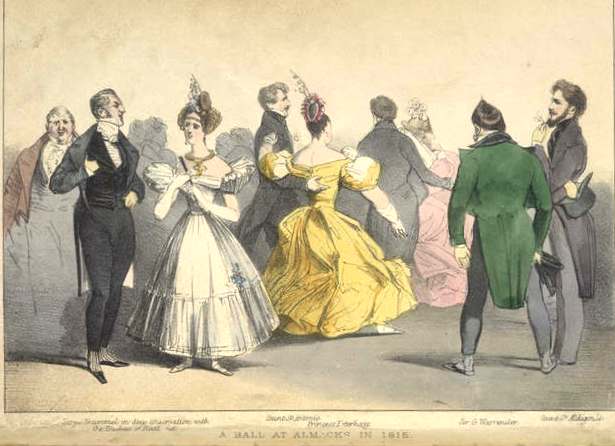
    He was so influential, in fact, that by 1815, you started seeing something familiar in the popular trends of the day:

    An illustration believed to be from 1815. Source: Wikipedia

    After this point, if you want to date the time period of an outfit (and historic fashion isn’t your special interest or profession), you pretty much need to base it of women’s* clothes, because western men’s formal clothes pretty much stagnated right here, save for small details. Lower-class and informal looks have more room for creativity, but only so much.

    (*in this post I talk about “men’s” and “women’s” fashions as I understand the categories existed in their time. I know bits and pieces about gender nonconforming presentation, historical nonbinary and agender people and the things they wore, but not nearly enough to speak about those subjects confidently.)

    So what’s this got to do with writing?

    Let me ask you: what does 19th century fashion look like in a world where Beau Brummell didn’t exist?

    You could make the argument that enough people were thinking about mass production, gunpowder, antibiotics, electricity, etc, that if the people we consider historically important today didn’t exist, somebody else would have eventually come up with those ideas. These kinds of advancements tend to build upon one another, with one technology presenting the opportunity for another.

    I can’t say the same about ol ‘Beau and what he did to men’s fashion.

    So what’s a writer to do? Do you stay with the historical trends and just handwave that some other dandy took Beau’s place as an influencer? Do you jut not mention coats and pants and hope people don’t notice? Do you examine pre-Beau trends and make up entirely new fashions that people might have worn if he hadn’t been around?

    That depends entirely on the writer and the story they’re telling.

    In my case, clothes and fashion don’t feature much in my story, so there’s nothing gained by my spending time, energy, and words coming up with new looks– and if the reader is already vaguely familiar with what I’m describing, then that’s reader time and energy that I don’t have to take up with my descriptions.

    Still, I have to wonder: what might fashion look like in a world without Beau?

  • This past weekend I gave a presentation at InConJunction in Indianapolis, and one of the attendees requested that I make it available online later on. So let’s give it a go!

    First of all:

    What is a Conlang?

    Conlang is short for “Constructed Language”, meaning any kind of artificially and intentionally created language. You’re probably familiar with them, considering that fiction is absolutely rife with them.

    (more…)