Antigone by Frederic Leighton; file from Wikimedia Commons
Creon: My dear, I woke up one morning and found myself King of Thebes. God knows, there were other things I loved in life more than power.
Antigone: Then you should have said no.
Creon: Yes, I could have done that. Only, I felt that it would have been cowardly. I should have been like a workman who turns down a job that has to be done. So I said yes.
–From Antigone by Jean Anouilh, translated by Lewis Galantiere
If you’ve never read or watched Jean Anouilh’s Antigone, I recommend it.
The above passage is between Antigone and her uncle Creon– and in this moment, they’re both tragic heroes. Antigone took a stand and refused to be part of a system that was unjust and immoral. Creon saw the same system and took charge in an effort to salvage it, because nobody else would try. In this moment they argue, furious and fiercely at odds, but neither of them are entirely wrong.
Choose your battles
There are some responsibilities we can’t shirk. Some deadlines that absolutely, positively cannot be fudged. And yes, there is a lot of honor in being reliable and faithful and strong.
But there are also times when what’s expected of us is beyond our capabilities. We can certainly try– and we might even succeed– but at the cost of physical and mental health, of family and relationships, and of the moments that we cherish. Often these things are asked of us by people who don’t fully understand our situation, or it’s meant with an unspoken ‘if you get around to it’. But they can be an endless source of stress and anxiety for someone who’s never been taught to say no.
The first step is learning to discern between what absolutely, positively, irrefutably cannot be ignored– and, in contrast, what tasks and responsibilities you can afford to push to the wayside. Because I can promise you, as overwhelming as they seem, they aren’t all do-or-die.
There’s no shame in refusing
Not being able to get through something doesn’t make you stupid, or lazy, or cowardly, or weak– but often we can feel like failures if we refuse a task that’s offered to us.
I know women especially fall victim to this a lot: we feel like we must be rising stars on our chosen career path, we must be perfect wives and perfect mothers, we must keep our homes clean enough to double as the set for a sitcom and decorated with an interior designer’s flair, we must have exciting and vibrant social lives– and we must, of course, do all of that while working out regularly, dressing fashionably, and having perfect hair and makeup no matter what the occasion. And that’s just talking from my experience as a woman– it’s no picnic to be a guy, either!
With all of this weighing on our shoulders, it can be incredibly difficult to refuse anyone anything. But it can also be incredibly liberating– and empowering– to take a step back and reclaim a part of our lives for just ourselves. To do the thing you want to do because you want to do it, and not because somebody else expects it of you. And sometimes, it can be necessary for your mental health.
Angie Sandro is the kind of person I get to brag about knowing– even more now that Dark Paradise (Grand Central Publishing/ Forever Yours) is shooting onto the shelves this July! So I’m super excited to be able to share the book’s cover with all of you!
As part of this event, she’ll be giving away a $25 Amazon Gift Card via a Rafflecopter giveaway, so definitely check that out!
Now, without further ado:
DARK LEGACY
Mala LaCroix has spent her whole life trying to escape her destiny. As the last in a long line of “witch women,” she rejects the notion of spirits and hoodoo and instead does her best to blend in. But when she finds a dead body floating in the bayou behind her house, Mala taps into powers she never knew she had. She’s haunted by visions of the dead girl, demanding justice and vengeance.
DEADLY SECRETS
Landry Prince has always had a crush on Mala, but when Mala discovers his sister, murdered and marked in some sort of Satanic ritual, he starts to wonder if all the rumors about the LaCroix family are true. Yet after Mala uses her connection to the spirit world to identify his sister’s killer, he starts to form his own bond to her . . . a very physical one. As they move closer to each other and closer to the truth, Mala and Landry must risk everything—their families, their love, and even their lives.
Dark Paradise will be hitting the shelves on July 1 of this year, but you can preorder it on Amazon.
Angie Sandro was born at Whiteman Air Force Base in Missouri. Within six weeks, she began the first of eleven relocations throughout the United States, Spain, and Guam before the age of eighteen.
Friends were left behind. The only constants in her life were her family and the books she shipped wherever she went. Traveling the world inspired her imagination and allowed her to create her own imaginary friends. Visits to her father’s family in Louisiana inspired this story.
Angie now lives in Northern California with her husband, two children, and an overweight Labrador
It may not be the most hilarious page Mr. Wiener* has ever penned, but it makes a lovely point about conflict.
(*Yes, that is his name.)
One person’s bad day is another person’s best day ever– and in a lot of cases, you can’t have one without the other. Take, for example, a lion and an antelope: either the lion and her cubs risk starvation and the antelope gets to live another day, or the lion gets to eat while the antelope dies a horrible death. Neither can win except at the expense of the other.
Often the people involved have no idea what’s going on, which creates room for all kinds of tragedy. A sweet moment between father and daughter becomes horrifying when it’s colored with the extinction of an unknown society. Hamlet’s single-minded investigation into his father’s murder takes a sickening turn when he unwittingly drives Ophelia to madness and suicide. Edmund’s fondness for that lovely woman in white and her Turkish Delights inadvertently gets Aslan killed.
Of course, when characters do know the whole story, it creates a whole different kind of conflict: suddenly you’ve got questions like “which of us deserves to come out on top?” and “is what I have to gain worth what they have to lose?”– the answers to which can speak volumes about that person’s character.
For the most part I’ve been dealing with pretty large-scale conflicts, but not every struggle needs to be life-and-death. Often you’ll find out as much– or even more– about your character by the way they handle small disputes.
It’s the year I got a house, the year I got a dog, the year I started grad school, the year I celebrated my fifth year being married to Boxy. Now that we had a place to hold them, we hosted a Halloween party, and a formal family Thanksgiving and Christmas– all for the first time. Michelle Hauck and I even started an editing business, which has been an adventure all on its own.
So basically, the past year involved me hitting a lot of what I consider to be the milestones that mark adulthood, with all the personal growth associated with it.
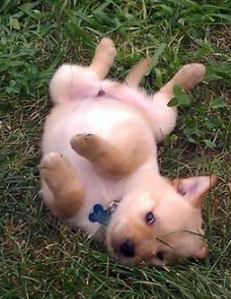
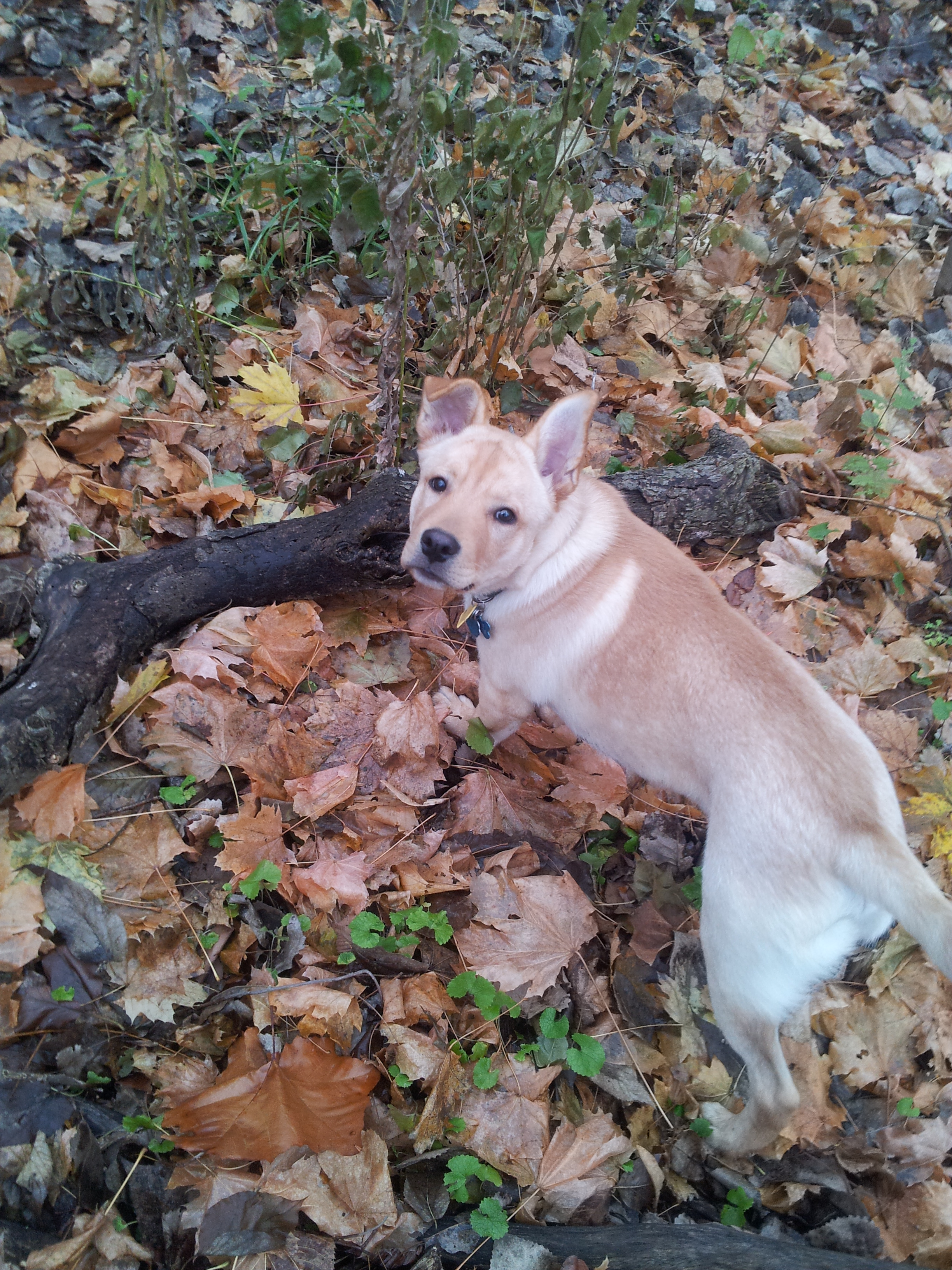
My puppy at six weeks and six months.
In the meantime, my writing has taken a bit of a hit… but on the plus side, I’ll call it an opportunity to learn from my failures.
This has been my first year competing in Nanowrimo and not completing the project. However, that’s taught me to prioritize my goals. My clients, classes, and family came first, which meant something had to go. And honestly, it was liberating to give myself permission to fail at something.
I’ve spent the entire year spinning my wheels with oneprojectinparticular, and famously, I’ve been re-writing three chapters in particular. At the end of the year I finally sat down in a diner with my muse, Kya, and actually asked her for help. What I got was phenomenal: she picked the story apart at the seams and then stitched it back together in a way that somehow managed to preserve almost everything I was proud of while fixing a whole plethora of problems that I’ve been struggling with all this time. In the interim, I’ve become more aware of some of my biggest weaknesses as a writer, and focusing on correcting those behaviors (and maybe, in time, work on turning them into strengths). And possibly most importantly, I’ve learned how to actually ask people for help.
My blogging has also fallen by the wayside, as some of you may have noticed. I’ll chalk that one up to learning to prioritize. But I’ve also moved my blog to this new location, experimented with blogging daily, and gained wonderful new followers.
Now for the annual New Year’s Resolutions:
Draw daily. There’s more than one kind of creativity, and it’s important to cultivate as many as possible.
Mark the holidays on my blog. There is, in fact, more to the universe than writing (gasp!), and I want to bring more of reality and current events into the blog. Not in place of writing, but as a supplement and a source of inspiration.
Finish Dreamkeeper and get it ready to publish. In the past I’ve focused on producing a large quantity of zero drafts and WIPs. The result is that I’ve got a lot to work with, but most of it lacks a degree of structural integrity. This year, I’d rather spend my time polishing instead of stressing over yet another shelved WIP.
The rest of my plans are less specific and more maintenance: keep my GPA up in school. Be the best editor I can be. Keep my house in some semblance of order. Cook more. Shop local as much as possible. And in general, try to be the kind of human being that I can look back at next January 1st and be proud of.
To finish, I’ll leave you with a quote by the ever wonderful Neil Gaiman:
I hope that in this year to come, you make mistakes. Because if you are making mistakes…you’re Doing Something.
There are more subtle ways of sharing your characters’ opinions. (Photo credit: iceman9294)
Whenever I meet a new volunteer at the bookstore, I introduce myself as Loudmouthed and Opinionated (seriously, my rants are pretty much legendary). But you don’t need to be able to go on hour-long rants to have an opinion. In fact, most opinions don’t need to be stated outright, because often they’re so ingrained in your worldview and belief system that it bleeds through into your everyday language.
This is also true about characters. And hopefully, those characters don’t spend nearly as much time as I do ranting their opinions to anybody who wants to avoid doing work for the day.
An important part of narration (especially first person narration) is finding the character’s voice. A lot of people accomplish this by making the character off-beat, sarcastic, funny, or just plain weird– but that doesn’t always mesh with the personality of your chosen narrator. A great way of bringing out that personality and adding color to that voice is to let the narrator’s opinions take forefront. The way they see the world will inform huge swaths of their perceptions of the world around them.
Consider the following sentence:
I walked into a large building that stood on a wide lawn.
That’s bland. It’s unimaginative. It’s boring. Now let’s add in some personality. A few made-up-on-the-spot characters and their opinion of the same building:
The longest uninterrupted vaulted ceiling in England (Photo credit: Wikipedia)
Architect: I hurried between an arrangement of Roman columns, glancing up at a vaulted ceiling so high I had to crane my neck to take in its full scope.
Agoraphobe: The building was a lousy shelter from the overwhelming expanse of the lawn; the pillars felt like some giant monster’s fangs, open wide to swallow me whole.
Guerrilla: The openness of the green space was unnerving. The inside of the building wasn’t much better, but at least I could take some cover behind the columns.
Gorilla: Finally I find some trees– but there’s something wrong with these. They’re cold and hard and have no branches. This place smells wrong, like lemon and leopard piss.
For each of these, that one sentence (or couple of sentences) might very well be the only time the building is ever described, and none of these are particularly time-consuming descriptions. But each of these sets the stage with a setting, a mood, and an insight into the mind of the narrator. The end result is often prose that is dynamic, compact and (hopefully!) just plain interesting.
I was watching this episode of the Nostalgia Critic, in which he analyzes M. Night Shyamalan’s travesty The Last Airbender and compares it to Avatar: The Last Airbender, upon which it was based. I recommend you check it out, too– you won’t be disappointed.
He made one point in particular, though, that stuck with me:
“You have a great set-up for an emotional moment. Aang is seeing all his past lives. The power and weight of who he is should hit him at this very point. But instead, what do they do? Try to explain more exposition… And that is the problem. Whether you’re aware of the show, or you’re not aware of the show, the movie is all explanation with no humanity. Why do you think they waited twenty minutes to ask [the protagonist] his name? Because that wasn’t what was most important to Shyamalan. The identity? Who gives a shit. It can’t be nearly as important as explaining and explaining and explaining and explaining.
I DON’T FUCKING CARE!
And you know why? Because I never once heard anyone in this movie say ‘I feel this’ or ‘I like this’ or ‘I wonder this’. There are no emotions being addressed. Traditionally storytelling is setting up a character, sending them on a journey, and learning more about them through the journey. Last Airbender is just chess piece storytelling. Character goes here. character goes there. Characters says this. Pawn to King Four. So in this scene, which should have been the emotional pinnacle of our main star, it’s just more explaining about what happened, rather than why it happened.”
We’ve all heard the standard “Show, Don’t Tell,” but I got something a bit deeper out of Doug Walker’s commentary: don’t let a work’s story usurp its soul.
What does that even mean?
Shyamalan’s problem with The Last Airbender was that he tried to include all the mythos and backstory of a three-season television series in a two-hour movie, and he does it at the expense of the characters emotions and interactions. I’ve noticed that I have the same problem in my own writing. I get so caught up in the backstory and worldbuilding that I forget that the characters are supposed to be taking center stage in this story. It’s what Walker calls “the most essential element of telling any story; if the character can never express any emotion, why should the audience ever express any emotion?”
The same holds true whether you’re trying to tell a character-driven story or a plot-driven story. The characters are our way of connecting to the events going on. If we can’t relate to them on some level, the story becomes little more than a textbook.
Like I’ve said, I’m still working on this myself. But here’s some fixes that I’ve been experimenting with:
If the backstory is more interesting than the protagonist’s story, try telling that one instead.
If a subplot is taking up needless space but isn’t strong enough to be swapped for the A plot, consider cutting it entirely.
If the reader doesn’t receive this particular piece of exposition/explanation, will they be utterly incapable of grasping the plot from this point on? If the answer is no, you’re probably safe to cut it.
That isn’t to say a deep and well-thought-out world and backstory is a bad thing. In fact, it can become fuel for the sorts of significant details that make a world feel lifelike, creates more well-rounded and interesting characters, and can add subtext to dialogue. But in all three of these cases, the effect is strongest when that backstory is omnipresent, rather than being described every thirty seconds. After all, you don’t need an advanced degree in physics to feel the effects of gravity. Just by seeing it acting around us, we have a pretty strong grasp of what it does.
Some of you may have noticed a lack of updates this month. Due to school being school, I’ll be changing my schedule to post every other week instead of weekly.
I was seriously considering a photo of a scalpel leaning on a pig’s heart, with a caption about ‘yeah, that’s what it feels like’. Because I love you, here’s a diamond scalpel instead. (Photo credit: Wikipedia)
It’s a writer’s job to explain, to take that vivid picture in your head and use words to paint it in mine. That takes a lot of effort, a lot of detail, and a lot of words. Sometimes, though, those words can clutter the sentences, bog down prose, or otherwise get in the way of the image. We’re left walking a razor’s edge: too many words, and you risk overwriting. Too few, and you risk not being understood.
(That’s the last blade-pun, I promise).
You might notice the problem: it’s very difficult to identify that line in your own writing. After all, you already know what you’re trying to convey. For a matter like this, which is dependent on clarity and reader understanding, I recommend getting a beta editor to look over your manuscript and point out which sections are unclear or overwritten.
What is overwriting?
There’s different varieties, but these are the ones I see most often:
Purple prose — When the writing calls attention to the author instead of the story or characters. Often it comes in the form of waxing poetic at length about… anything, and it typically comes across as the author trying too hard to be fancy. That’s not to say good writing can’t be poetic, but you’ll often get a stronger effect with a single significant detail than with a paragraph-long abstract description.
Needless repetition — Sometimes it’s as subtle as using both a dialogue tag and an action beat for the same section of dialogue. Sometimes it’s characters repeating the same information to one another. Sometimes it’s a word or phrase being reused too frequently in a short space, when one or more of them could be replaced by a synonym. And sometimes it’s the same detail being given in two different ways.
Understood — “He reached down to his belt level, wrapped his hand around the hilt of his sword, tightened his grip, contracted the muscles in his arm and shoulder, pulled the weapon from his scabbard, and raised it into the air in front of him.” Or, once my scalpel has had its say: “He drew his sword.” There are a lot of secondary and tertiary details that readers will assume to be true when they’re given a little bit of context. The biggest offender: “he said, looking at her.” If two people are in a conversation, unless it’s explicitly stated they’re avoiding eye contact, we will always assume they’re looking at one another, because that’s the way people hold conversations (outside of movies and television, of course).
Unnecessary words –– Descriptors can often be trimmed if they’re understood. For example, “He sat down in the chair” can usually be slimmed into “He sat in the chair” (unlike “he sat up in the chair”, which indicates an entirely different action). Similar examples include “stood up” and “woke up“.
These are all things to give you ideas, but like all writing, it’s subjective. In the end it all comes down to whether that word or phrase helps to create a vivid image or emotion in the reader’s mind, or whether it’s just clutter. .
I like to think of myself as a casual gamer, more interested in stories than actual shoot-em-up action– which is why Amnesia: The Dark Descent is a big favorite of mine (even if I can’t fix the stupid elevator). While playing Amnesia’s shorter tangent, Justine, I wound up in what I fondly like to think of as the Potato Room. (Starts at 8:00)
(Note: works best when watched full-screen in a dark room).
Part of the gameplay of Amnesia is the utter helplessness of the main character. Trapped in a castle full of monsters, you have no hit points and no way to fight them. Your only hope is to run and pray they don’t catch up, or hide until they pass you by. Unless you’re in the Potato Room, apparently, where a monster circles endlessly through a room, and you have to sneak past it unnoticed.
I didn’t know this the first time I got to this area. So when I heard the monster coming, I hid in the corner, behind a bookshelf, and waited. My lights ran out, and my character quickly lost her sanity in the dark. The screen pulsed in and out of focus to the sound of her frantic heartbeat, and she repeatedly lost consciousness and fell sideways, in what I’m guessing is a fetal position on the floor. For (I kid you not) twenty minutes of real time, I sat and waited, straining my ears for snarls and growls, unable to look at the monster without my character passing out again.
Then I had a friend look up a walkthrough, and I felt rather silly for trying to wait out the monster instead of sneaking past.
Not too long after, my husband initiated a conversation he and I very much needed to have. I no longer remember what it was about, but it was one of those things that I very much needed to do, and very much didn’t want to. The cornered, desperate feeling started me on a slight anxiety attack. My heart was racing, my breath was shallow… and when I shut my eyes, I could see the Potato Room: the darkness, the shadows crawling in the distance, the pulsing screen, the sounds of the monster shuffling closer by the second. Since then, the Potato Room has essentially become the place my mind goes when I get anxious and frightened.
The power of Potatoes
This isn’t unique. Into The Free opens with Millie hiding under her porch and witnessing a mother dog killing and burying her litter of newborn pups– which is referenced again almost every time we see child abuse throughout the book (and dear lordy, there’s a lot of it). In Going Bovine, Cameron begins his story by retelling the day he almost died on a ride at Disney World– a bittersweet experience which he describes as the happiest day of his life. But while the technique isn’t unique, it’s often unique to that book. The sorts of experiences strong enough to become a character’s Potato Room are often mundane (unlike, for example, a first date or first day of school, which are usually considered noteworthy), but they’re weighted with a particular emotion that makes the place leap out every time that emotion resurfaces. They’re a great way of really delving into the depths of a character and giving them a detail that is purely his or her own.
Do any of your characters have a place that holds particular emotional weight for them? Where is it, and what emotions are attached to it? Tell us about it in the comments!







 JWTroemner.com