JWTroemner.com

Home of JW Troemner and Urban Dragon

  • Sorry, needlessly complicated subplot. We're gonna have to let you go.
    Sorry, needlessly complicated subplot. We’re gonna have to let you go. (creative commons, source: wikipedia)

    This is the second part of my response to this blog post, asking about writing woes.

    I write fantasy. And because it isn’t rooted in our world, that means I have spent a whole lot of time worldbuilding.

    My current WIP deals with the interaction of three separate countries, as well as the influence of a fourth country that’s only mentioned in passing. Each of those countries has a dominant religion (or in Tarlam’s case, several dozen religions vying for dominance), creation myths, geography, technology, primary imports and exports, unique social structures, languages, taboos, dominant attitudes toward gender and sexuality, histories, virtues, vices, etc, etc, etc.

    Each of the characters has their own backstory which shapes his or her attitudes and behaviors– and these actions have consequences. Some of those backstories overlap and influence other characters.

    What’s frustrating is that many of these details will never see the light of day. I’ll know them, but they’re not relevant to the plot, so often they will sink beneath the surface, becoming little more than currents and subtexts. Sometimes one of the biggest writer woes is the struggle to know what to cut, especially when you really liked it.

    Here’s an example from DREAMKEEPER:

    Twenty years ago, one of the major characters helped send a ship full of refugees to a neutral country. While some of those refugees went into hiding, others banded together to form a resistance against the forces that drove them from their homes. The son of one of those resistance fighters grew up to become a spy, and planted himself as a footman in the same house as Aren, the protagonist. For years now, Aren’s been mistaking his attention for a crush, when in reality he’s been doing surveillance on her.

    He’s still in her household, keeping watch– but in more than 100k words, he gets mentioned maybe twice. He doesn’t even have any lines. Because while he and the resistance are effective elsewhere, they don’t actually influence Aren’s story. And that means they got the ax.

    Me, I like to think his story was interesting. But that’s what they’re talking about when they say to murder your darlings.

    What about you? Have you had to cut any characters or subplots like these? Here’s a chance to share the darlings that might not get to see the light of day!

  • Zugspitze von der Alpspitze aus gesehen. Links...
    (Photo credit: Wikipedia)

    I was reading this blog post, which asked, “what are your biggest writer woes?”

    One of my biggest– the one that’s currently got me beating my head against a wall– is what I like to think of as finding the right path up the mountain.

    Our Hero has made her grand journey across perils unnumbered, and needs to find the next clue. It’s at the top of that ol’ mountain over there. I know it is. Seriously, it’s right there.

    The problem is, I can’t figure out how to get my Hero up that slope. She could just skip on up there, but that rings false and shallow. She could go through endless harrowing experiences, dealing with avalanches and close encounters with cliffs… but this mountain is just one tiny obstacle, not the subject of the entire book. In the end, I just want my Hero to get up the damn thing so she can move on to the next plot point, but do so without it seeming too trite or too over-the-top.

    There are a lot of ways to handle this, and each situation usually requires three or four coping mechanisms to chug through:

    • Rewrite the trek up the mountain. And then rewrite it again. And then rewrite it again. I have a single minor transition scene that has nearly a dozen completely different incarnations for this reason exactly, and my final draft ended up being a combination of several of them.
    • Talk to someone who’s unfamiliar with the story, or only passingly familiar. Kya is my go-to with this sort of thing, but there’s only one of her and I’ve got dibs. Sometimes just the act of explaining the problem is enough to get you thinking in the right direction.
    • Read a book. Watch some good TV (or hell, watch SharkNado). Take a break from your own efforts and try to absorb how other people handle story.
    • Act it out. It’ll look silly, but you and your best friends are going to have a grand ol’ time, and you’ll be amazed at what you find.
    • Ask a professional. If your character is trying to climb a mountain, then locate a mountaineer and interview them. If you’re trying to get through a cave, find yourself a spelunker, and so forth. They’ll have insights you couldn’t even dream of.
    • Crowdsource. Ask a whole group of people about the problem and see what they come up with.

    Do you ever struggle with this sort of thing? What do you do to find your way up that mountain?

  • Two of your characters, who are the most bitter of enemies most of the time, unwittingly sit down and have a chat. Maybe they met up on Chat Roulette (is that even a thing anymore?), maybe they’re a superhero and supervillain who ran into each other out of costume. Whatever the case, at least one of them (perhaps both) doesn’t know who the other is.

    What do they talk about? How do they treat each other? Do they broach the subject of their rivalry, or do they steer clear of it?

    This sort of conversation isn’t uncommon in fiction (or in real life, for that matter), but it does make you look at this antagonistic relationship in a different light.

  • In case you hadn’t heard, Michelle Hauck and I are working together as freelance editors.

    Today I’m proud to announce that not one, but two of our clients just hit the shelves!

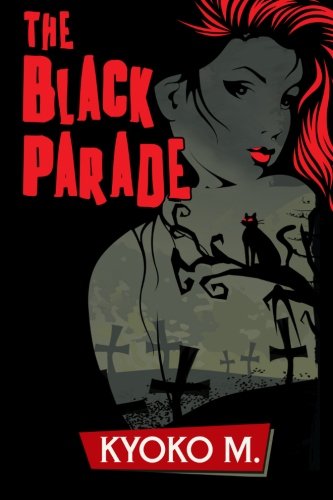
    black parade Kyoko M. just came out with her first book, The Black Parade, an urban fantasy NA thriller with a holy twist. 

    One bullet is all it took to transform eighteen-year-old New Yorker Jordan Amador into the last hope for souls of the dead. However, it also transformed her into a cantankerous asocial waitress with a drinking problem. Jordan accidentally shot and killed a Seer: a person who can communicate with ghosts, angels, and demons. Worse still, she did so on the eve of her own awakening, making her the last Seer on Earth with no one to guide her. As penance, God gives her two years to help one hundred souls with unfinished business cross over from Earth to the afterlife or she will go to Hell. Just as she approaches the deadline, Jordan finds her hundredth soul: a smart-mouthed poltergeist named Michael whose ability to physically touch things makes him distinct from her usual encounters with the dead. However, the deeper she delves solving his sudden death, the more she realizes something sinister is on the horizon. With time running short, Jordan stumbles across a plot that may unravel the fragile balance among Heaven, Hell, and Earth. Her life is plunged into chaos as she is hunted by demons that want to use her valuable Seer blood to bring about the end of the world and discovers that these creatures have a frightening connection to her family bloodline. Plus, the budding romance between Jordan and Michael makes it harder for them to let go of each other so he can become part of the eternal black parade.

    Kyoko M is a recent graduate from the University of Georgia with a Bachelor of Arts in English Literature. She hails from Riverdale, Georgia, a metro-Atlanta city, and currently lives in Ocala, Florida working on her novels. She has written articles for toonaripost.com, and is a 2011 winner of National Novel Writing Month for her title The Starlight Contingency, as well as being a first round finalist for the 2013 Amazon’s Breakthrough Novel Contest for her debut novel The Black Parade. She has a passion for urban fantasy, science fiction, high fantasy, supernatural, and paranormal works. She is also known for being a sarcastic nerd whose influences include comic books, anime, movies, and various novel series.

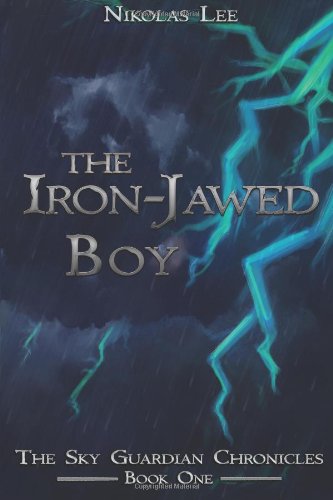
    iron jawed boyKyoko is joined by Nikolas Lee and his debut, The Iron-Jawed Boy, the first installment of The Sky Guardian Chronicles. It’s a cross between Harry Potter and Percy Jackson, set so far in the future that it curves back around and starts looking like the past. 

    Being the freak with the iron jaw isn’t easy for Ionikus Reaves. It’s cold, heavy, and worst of all, it’s bound to his skin with magic. Father attached it, but left only a riddle as to why, and now he’s in the war, fighting on behalf of the pompous, evil Illyrian gods who drafted him. Now with Father gone, Ion blames no one but the Illyrians for his new freak status. Then Ion discovers that, due to an incredibly infuriating reincarnation, he’s a Guardian: a wind-riding, lightning-toting god created to serve the Illyrians he so hates. The gods promise to free Father, however, and possibly solve the mystery of Ion’s jaw–so long as he agrees to train as a Guardian–and Ion accepts. But Ion soon finds his new world to be a dark, secretive one, where not every promise a god makes, a god keeps, and not accepting who you are…can have the deadliest of consequences.

     Nikolas Lee was born in Evansville, Indiana, moved with his family to Las Vegas, Nevada, when he was eleven, moved back to Indiana when he was fourteen, then moved back to Las Vegas when he was sixteen. No, neither he, nor his family are under the witness protection program. Though that would be much cooler than the real reason. He currently resides in Santa Monica, California, where he’s usually watching anything with Tina Fey in it, or writing. He and Ion have been friends since he was eight years old, when Ion’s name was Thunder and Nikolas’s concept of proper comma usage was poor at best.


    Both of these books are fantastic reads, so what are you waiting for? Hurry up and grab a copy!


  • People Watching

    People in the Bus for Public Transportation
    The bus is a great place to sit back and observe. (Photo credit: epSos.de)

    I was digging through some old notebooks this evening when I found a page of People Watching.

    You can’t ever hear enough about this: writers, artists, filmmakers– no matter what your brand of creativity, it’s imperative that you go out and actually look at people.

    I’m not talking about the standard stuff– you know, the way we usually get categorized:

    • Sex: Male/Female/Etc
    • Skin: Black/White/Brown/Beige
    • Eyes: Blue/Green/Brown
    • Hair: Long/short/bald
    • Body: Fat/Thin/Tall/Short

    If you’ve ever got a spare moment– whether you’re waiting on the bus or enjoying a lunch break– take a second to look at people. Actually look at them. Listen to the way they speak. Watch the way they move and hold themselves. Observe what they look like. The features that catch your eyes. The mannerisms that make you take notice.

    Even if you don’t think of it consciously, those descriptions will start to bleed into your work.

    Here are a few from my list, written down while I was killing time between classes during my undergrad:

    • A small face on a small body, all mousy and pale, with radioactive pink lips glowing in the middle of her head
    • Thin, with dark hair like quills hidden under a crocheted cap
    • A Willy Wonka crooked grin (Gene Wilder, not Johnny Depp), with milk chocolate skin and sugared-coffee hair
    • Long, twiggy hands
    • He had a complexion like raspberry jam, flushed and pocked and all the more sweet because of it
    • A round face like an almost-full moon, encircled by night-black hair
    • Her confidence betrays a deeper self-consciousness. She uses too many big words, struggles never to smile or look too happy. Every action underlines a single message, bolded and underlined until the print of her face runs out of ink: THIS IS IMPORTANT! TAKE ME SERIOUSLY!

    (That last person was talking about her classes. You get a cookie if you guess her major.)

    Have you observed any interesting people lately? How do you feel about people watching? Tell us about it in the comments!

  • I ended up doing a lot of research for yesterday’s post, and editing some of that out. One of the things I found was a list of women that you don’t really hear much about– not the wives of famous people, but women who held what I fondly think of as “non-traditional” careers.

    English: Belle Boyd.
    English: Belle Boyd. (Photo credit: Wikipedia)

    (Pulled from http://www.lkwdpl.org/wihohio/figures.htm)

    • Margaret Bourke-White (1904-1971) – Groundbreaking photo-journalist and author
    • Mary Elizabeth Bowser ( 1839-?) – African-American Union spy in the Confederate White House.
    • Belle Boyd (1844-1900) – Confederate spy during the Civil War
    • Martha Jane “Calamity Jane” Cannary (1852-1903) – A lone woman in the wilds of the Rocky Mountain west
    • Rachel Carson (1907-1964) – Marine biologist, science writer, and environmentalist.
    • Cassie L. Chadwick (1857-1907) – Most infamous Cleveland financial con-artist.
    • Emma Goldman (1869-1940) – Vilified in her day as the “most dangerous woman in America,” this Russian emigrant earned her title, “Queen of the Anarchists” as labor leader, lecturer, writer, women’s rights activist and free love advocate.
    • Anne Hutchinson (1591-1643) – A Puritan woman who defied the male-dominated Massachusetts Bay Colony and after banishment helped settle Rhode Island and New York.

      Molly Pitcher at the Battle of Monmouth
      Molly Pitcher at the Battle of Monmouth (Photo credit: Wikipedia)    
    • Rebecca Jackson (1795-1871) – African-American eldress of the Shaker sect.
    • Hedda Hopper (1890-1966) – In the golden age of Hollywood, Hedda could make or break careers. Gossip was her business and J. Edgar Hoover was her penpal.
    • Marie LaVeau (1796?-1863?) – African-American Voodoo Queen of New Orleans and famous herbalist.
    • Molly Pitcher (Mary Ludwig Hays McCauley) (1754-1832) – Born Mary Ludwig, this revolutionary heroine followed the Continental Army for more than 3 years, doing what was needed to free the colonies from the tyranny of England.
  • If you look at the majority of non-modern fantasy, be it medieval, pseudo-victorian, what have you, you’ll notice a pattern: everybody’s white and straight. If genderqueer or homosexuality is brought up, it’s with a heaping helping of homophobia and transphobia; if people of color are included, you can expect to see racism that would make the KKK hang their hoods in shame. And if a woman has a “non-traditional” role, it’s because she’s a spunky, norms-defying rebel.

    Guys, it’s getting old.

    “But we’re just being historically accurate!” you may say.

    Historically accurate for some times and places, sure. But remember, there are plenty of other houses to rob.

    Yesterday I talked about borrowing story elements from more than the few overtapped sources that have donated to most of our mainstream media. But when I say we should look at other cultures and sources, I wasn’t just talking about mythological animals and pantheons.

    From the Library of Congress: TITLE: Thos. W. ...
    (Photo credit: Wikipedia)

    Let the spectrum in

    William Shakespeare gave us what I consider a compelling Primary Source Document on the presence of POCs in European society when he wrote Othello.

    The movie Arabian Nights did a great job of portraying the way international interaction happened in a lot of the ancient world: we have an African wizard venturing out to China to make deals with Aladdin; we have Englishmen and Chinese men and locals alike living within a few blocks of one another in a bustling metropolis.

    And that’s the thing– any major urban area is going to attract people from all over the world, especially traders selling rare exotic goods to the social elites. Often enough those traders will be foreign themselves, or have non-locals in their caravan/on their ship/etc. Unless there’s some major isolationist movement going on, there should be a healthy population of out-of-towners.

    Homophobia is so 1950…

    Keep in mind that

    • Gay male relationships were considered the purest form of love in ancient Greece, and Plato believed that only barbarians would condemn such a love
    • Historical records suggest that bisexuality was considered the norm in China before the Tang Dynasty
    • In New Guinea it’s believed that sharing semen through male/male sex promoted growth, while excessive heterosexual sex led to “decay and death”
    • Several cultures have a third gender (or more than that!)
    • There are entire websites dedicated to this sort of thing. I recommend you check them out.

    Women wearing the pants

    Several cultures are matrilinial in their leadership and inheritance. Even among cultures that weren’t, women were often encouraged to know how to fight.

    Keep in mind that females have held pretty much every conceivable male role. History is full of powerful female rulers, such as Hatsheput of Egypt, Empress Wu Zeitian of China, and Queen Elizabeth I of England. Hell, the world’s first novel was written by a woman (The Tale of Genji, by Murasaki Shikibu of Japan). There are plenty of websites to explore on that topic as well.

  • It’s no secret that I’ve got a bit of a sore spot regarding certain elements in fiction: specifically, I’m frustrated by a glut of fiction featuring Tolkien’s Elves/Dwarves/Men, the standard Vampires/Werewolves civil war, the obsession with Norse and Greek mythology.

    It’s not that these elements are bad– not by a long shot. But I’ve seen them so often that I’m getting sick of them.

    This morning a philosopher friend of mine came over, and we talked about a whole slew of things (topics always tend to wander when he and I chat), and while we meandered onto the subject of literature, an old phrase came up:

    Good writers borrow; great writers steal. 

    It’s been attributed to Oscar Wilde, Pablo Picasso, TS Elliot…it’s such a good quote that nobody can keep their mitts off it. But I digress.

    The philosopher framed my frustration in terms of the quote, and we wound up with this scenario

    (Note: This is all metaphorical. I don’t actually endorse stealing stuff in the real world.)

    Living Room - Big Couch
    It’s nice, but it could use a touch more Coelho… (Photo credit: TomBorowski)

    We writers are a pretty light-fingered bunch. Like I’ve said before, most of what we create is based at least partially off something else. When we see another author use something we like, we can’t help ourselves– we just have to grab it. Some people are careful about the matter; they’ll file off the serial numbers and give it a new paint job, but it’s still got the same base underneath. Some get proud of their acquisition. They proudly announce that the mirror in their front hall belonged to HP Lovecraft, and that at midnight you can see Cthulu reflected in its glass. And that couch you’re sitting on? That’s a Tolkien original, swiped straight out of the Last Homely House.

    The latter are lovingly referred to as tributes, homages and allusions, and they can be pretty damn cool… but some of the coolness wears off when you start to notice all your friends have the exact same couch in their living room. After a while it starts to look a bit threadbare, and you’re pretty sure a spring is coming loose underneath the cushion.

    This doesn’t change the fact that it’s still a damn comfy couch, and hell if those Elves don’t know their way around upholstery. But it’s starting to look… old. After all, even if Tolkien had some great stuff, but there’s only so much of it, and those sticky-fingered writers have rearranged it those same pieces in every configuration imaginable.

    Bay Ridge McMansion 1b
    Just look at all those potential plot points… (Photo credit: Whiskeygonebad)

    But while Tolkien’s house has been pillaged down to the studs, there’s a whole city full of houses to rob. Hell, a few miles up the road you’ll find a veritable neighborhood full of McMansions, each full of themes and archetypes and symbols and mythical creatures, almost untapped by the kleptomaniac writing population. Maybe you’ll find a better couch for your decor in one of those. Or maybe you’ll decide to keep your classic Tolkien couch, but jazz it up with a Tale of Genji area rug and some Aztec cushions. Maybe your HP Lovecraft mirror would look better with some ancient Nubian wallpaper.

    How would your medieval High Fantasy be different if, instead of Elves, one of the dominant races resembled shapeshifting Encantado?  What if your werewolves had more in common with hyenas? And moving past the superficial, what lessons and motifs can we glean from the fairytales of, say, India? There are values systems, fashions, family structures, mannerisms, superstitions, combat styles– many of them unknown and unappreciated in the mainstream.

    There’s a whole world out there, my fellow thieves. I invite you to explore it all.

    (Note: I fully expect somebody to call me out for encouraging cultural appropriation– namely, grabbing stuff from another culture because it’s nifty, and usually horrifically stereotyping and misrepresenting a that culture and its members as a result. First of all, this happens a lot. It’s not good, but it does. Second, just because a creature/theme/clever anecdote doesn’t belong to your native culture doesn’t mean it’s off limits. There’s such an incredible wealth of stories out there that you would be doing yourself a disservice by only skimming the surface and taking the most obvious details. I find that some of my favorite fantasy cultures/creatures/settings are ones which are not drawn wholesale from another culture, but inspired by aspects of an extant culture/myth/setting, and then advanced and reworked until they are something entirely new. And that’s something I’d love to see more of in the future.)

  • I was just scrolling through my Reader on WordPress when I spotted this blog post, about a book called THE DREAM KEEPER, which involves a creature called a shifter.

    In case you haven’t heard, my WIP is tentatively called DREAMKEEPER, and features a race of people called shifters. 

    There was a time when this coincidence would have royally freaked me out. What if my idea really isn’t original after all? What if people confuse the two books? What if–

    You get the picture. 

    Image
    I’m pretty sure that book doesn’t have one of these either… but that may have more to do with the fact that I can’t really draw.

    These days, though, I just chuckle and take a closer look. Beyond the surface details, Mikey Brooks’ THE DREAM KEEPER has nothing to do with my story. One is a modern MG, the other is a NA that takes place in a pseudo-Edwardian war zone. They both spend a significant time dealing with dreams, but for completely different reasons, and with completely different rules attached. Though both may have some similar themes (like trusting your enemies), they’re entirely different interpretations on those themes.

    I once took a writing class in college where three of us wrote stories to turn in on the same week, and completely independently we all came up with a story that revolved around a god masquerading as an elderly homeless man (okay, so in one story he was the patron deity of the homeless, but he still looked like one). But aside from sharing that detail (and a few other details that naturally accompany such subject matter) we all had overwhelmingly different stories. One was a reflection of Zen Buddhism, one was an epic adventure, one was more of a Hans Christian Andersen-style fairy tale.

    And that’s the beauty of creativity.

     It’s said that there is no true originality– everything is just a rehash of something else. As Mark Twain said, “What a good thing Adam had–when he said a good thing, he knew nobody had said it before.”

    But just because a subject has been tackled before doesn’t make it off limits. Nobody has every tackled that subject quite the way you will. And the more you study the works of others, the more you can learn which ways a thing has already been done, and which directions they haven’t yet thought to twist it. 

  • Comment 2
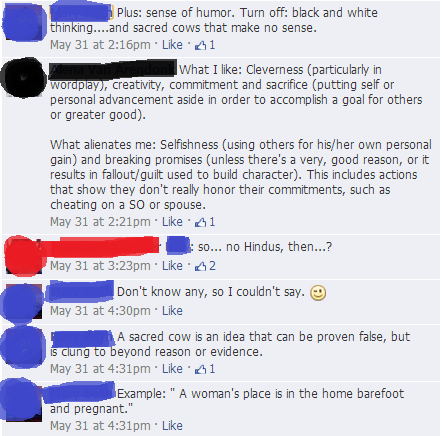
    The results of one of my crowdsourcing endeavors

    Some days you just need some opinions.

    Maybe you’re torn between names for your protagonist. Maybe you’re having trouble coming up with a minor character’s motivations, or the right job for the love interest. Maybe you’re just interested in finding out what people think makes a good protagonist.

    Sometimes, the best way to find new ideas is by crowdsourcing: asking a whole group of people for their input and ideas. I’ve tried a whole variety of methods: I’ve asked the same question of a whole lot of people in person, I’ve asked around on Twitter, I’ve posted questions and polls on Facebook.

    In my experience, the best results I’ve gotten have been from active writing groups on Facebook– I prefer ones like Nanowrimo, Writer Unboxed, and the New Writers Help Group. If you’ve got questions that are specific to one genre or topic, try going to a group specific to that topic, like this Steampunk group over here. Often members of Facebook groups are excited to help, and are willing to cast a vote or give a quick comment. You might even get in contact with experts in the field, whom you could interview for more in-depth information.

    If you don’t get results right away, don’t get discouraged. Try sourcing from a different crowd.

    Have you tried crowdsourcing? What’s worked for you, and what hasn’t? Let us know in the comments!