JWTroemner.com

Home of JW Troemner and Urban Dragon

  • Mood Whiplash

    Alex and Chris are running from the monster. Alex is pretty sure there’s a bit of their mutual friend, Pauline, on Chris’s shirt–

    possibly part of Pauline’s kidney– left over from their last narrow escape from the beast. Every breath comes in a gasp as they turn yet another corner, and they can hear the monster gaining on them.

    Chris pulls Alex into a side corridor and slams the door shut behind them, barricading it with a filing cabinet in a burst of adrenaline.

    Suddenly Alex can’t help but feeling aroused– Chris has never looked so sexy before.

    Cue heartfelt confessions of attraction, followed by a hot-and-heavy makeout session.

    This, my friends, is known as mood whiplash.

    It’s what happens when we’re on one emotional track, and suddenly get sideswiped by something else entirely.  This can be incredibly powerful when it’s used wisely, but it can be a deal-breaker when it hits us in the wrong way.

    When you start out in a positive emotion and get derailed into a negative one, you get drama. Horror and tragedy arguably work best when they’re blindsiding you– If you pile on failure on top of failure, or fear on top of fear with no hope of respite, then the readers are going to wind up feeling exhaustion rather than that visceral fear or grief (depending on the work, exhaustion might be the point, but it should be deliberate regardless).

    Here are two examples of using mood whiplash to create drama:

    • Cindy is about to leave for her dream job with her fiance, and everything is happy and fantastic… until she finds her fiance’s severed head in her office chair.
    • Jackson is out celebrating his retirement with the rest of the precinct, when suddenly a mob boss comes in and guns the place down, killing everyone but Jackson himself.

    However, mood whiplash doesn’t always have to be Postive–>Negative. For example:

    • Little Jimmy’s feeling dejected. He was so excited about the playoffs, but then he missed the big catch and his team lost by a landslide. He’s sure he’ll never be happy again… but when he opens his door, he finds a brand new puppy waiting for him!
    English: Robert Plutchik's Wheel of Emotions
    English: Robert Plutchik’s Wheel of Emotions (Photo credit: Wikipedia)

    That last one works because of the emotional weight or impact of the events. Getting a great new job is a big deal. Stubbing your toe or getting a parking ticket on that day are bummers, but they’re not going to break the emotional high you get from all that hope and excitement. The only thing that will break that high is either a whole dumptruck of disappointments, or else a single major event (finding your lover’s severed head) to make your whole world come crashing down.

    In the same way, a bowl of ice cream might not be a big enough emotional buoy to lift Little Jimmy out of his slump, but a puppy sure is.

    The big change needs to be of greater emotional weight than the previous trigger. For example, a shopoholic might go splurging to ease the pain of a loved one’s sudden murder. Being totally fine and chipper upon getting a good deal on a pair of stilettos, however, is going to make this shopoholic look shallow and a bit deranged.

    Any kind of mood whiplash is going to be jarring, which works very well for horror and tragedy. Most positive emotions, however, rely on some degree of comfort, which puts them at odds with that jarring dissonance. After all, how did you feel about Chris and Alex in the example above, making out while covered in splatters of Pauline?

  • Been a bit busy

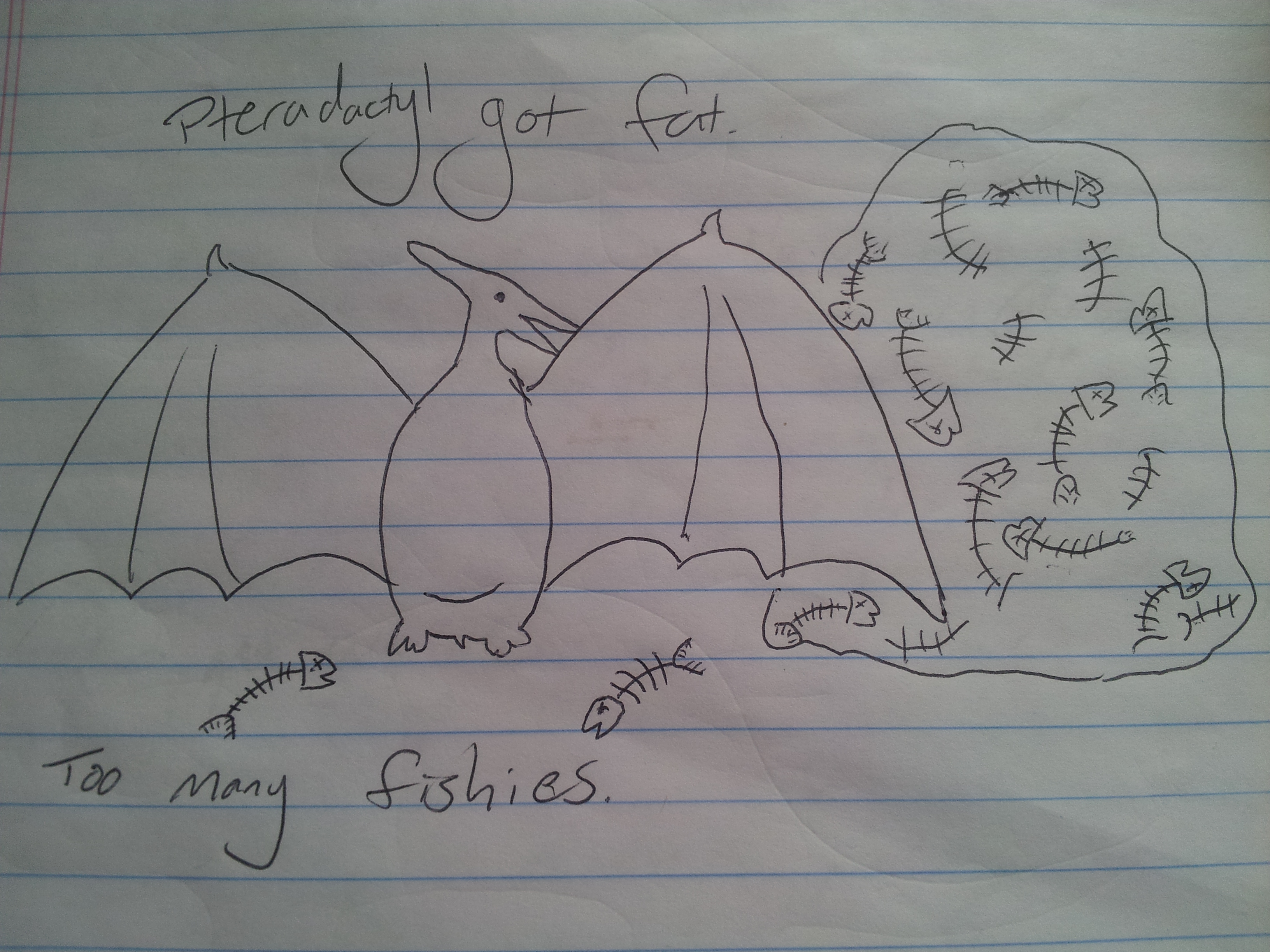
    Pterodactyl got fat. Too many fishies.
    Pterodactyl got fat.
    Too many fishies.

    Hey guys,

    This is just a bit of housekeeping to let you know I’m okay and all is well.

    This past weekend I went to Starkid’s Twisted (It’s very good, and I highly recommend you watch it once it becomes available). Between wrestling my health and the mountain of homework that’s been steadily piling up, blogging dropped down on my list of priorities. However, I’m still taking part in the 31 Day Blogging Challenge. I’ll try to make up for the days I’ve missed, in true WriMo fashion, and I’ll make an effort to continue blogging daily for the rest of July.

    To make up for my absence, here’s an old doodle of an overweight pterodactyl.

  • 935211_10152891404485246_2097919417_n
    Considering I’d been driving nearly 20 hours when this photo was taken, I think it’s one of my better ones.

    I’ll be entering the Like A Virgin Contest this July. One of the events is the official “Getting to Know You” blog hop, where we’re hoping to meet some other contestants, potential beta readers and critique partners. If you’re interested in becoming writing buds, let me know in the comments! Admission to the contest is still open, so if you’re interested (and you have a contest-virgin up your sleeve), come check out the contest and join in the blog hop!

    1. How do you remember your first kiss? I like to think of it as bold. So far my experience with romance had been reading and writing romantic fanfic… and as it turns out, it’s not entirely realistic. When Boxy moved in to kiss me (yes, my husband was also my first kiss), I did exactly what the heroines in all my favorite steamy fics did: I turned it into a full-on make-out session. Maybe it’s not conventional, but we both had a lot of fun.
    2. What was your first favorite love song? I’m guessing somewhere around 90% of songs are love songs in one way or another. My first favorite that I thought of as a love song, though, was Desert Rose by Sting. It’s not a love song to any one person– it’s more about the enchantment of being in love. I used to call the local radio station constantly begging them to play it, but the only times I ever heard it on the radio were completely by accident. How’s that for a metaphor?
    3. What’s the first thing you do when you begin writing for the day? These days, I start by making a to-do list of all the stuff I need to get done by the time I get to bed, and my #nifty350 is always at the top of that list, and it’s the first thing I cross off. Sometimes I only get 350 words written, and sometimes I get really into it and write a couple thousand.
    4. Who’s the first writer who truly inspired you to become a writer? Amelia Atwater-Rhodes. She wrote her first book when she was thirteen, and it wasn’t about the sort of stuff I was used to– instead it was about pretty much everything my teenage self wanted to be. Atwater-Rhodes could do it, and she didn’t need a Hemmingway-esque alcohol problem alcohol or drugs or grad school (which includes alcohol and drugs with the cost of tuition) or even “life experience” to get there. She just had a story to tell, and she told it. So why couldn’t I?
    5. Did the final revision of your first book have the same first chapter it started with? Excuse me while I peel myself off the floor, I’m laughing too hard. I’m actually torn between what I’d call my “first” book. DREAMKEEPER is the first story I started writing with any serious intentions… but even then, it was just a fanfiction at the time. So the original first chapter was about a poorly disguised fictionalized version of myself crawling through a secret door in my her closet door and coming out just outside of Rivendell, and then met an orc who remembered being an elf before the whole Silmarillion deal went down. I didn’t even get to chapter five before it wasn’t even recognizably associated with The Lord of the Rings anymore. At least two dozen redrafts, rewrites and re-imaginings later, only a few accidental details bear any resemblance to the original fanfic. Hell, even the tech level got nudged forward by a few hundred years. Someday I’d love to host a contest to see who can figure out which of my characters started out as which LotR characters. I think the truth might surprise you.
    6. For your first book, which came first: major characters, plot or setting? The first book I finished writing (my other first), started with a name: Chicago. I had a very clear mental image of this character– blond, quick and scrawny, wearing oversized clothes and shingle tiles for bracers– and immediately I knew all Chicago’s friends and family would also be named for cities, and that this would be a post-apocalyptic story. What I didn’t know was Chicago’s gender. I ended up having to consult my little sister to decide whether Chicago was a masculine or feminine name. The rest fell into place from there.
    7. What’s the first word you want to roll off the tip of someone’s tongue when they think of your writing? I don’t want a word– I want a laugh, or a squeal, or a gasp, or one of those tumblr-famous keyboard mashes. What I want more than anything is for my writing to leave somebody speechless.


  • If you’re not familiar, popular author and awesome blogger Chuck Wendig does a little ditty known as Search Term Bingo. The deal is thus:

    WordPress includes a feature where it tells us what search terms led people to our site. Some of them make perfect sense. Others, however, can get downright silly. So what Chuck does (and what I’ll be doing today) is post the latest search terms and add commentary. Some of these are variations on the same theme, so I’ll be combining them.

    So without further ado, here we go:

    BIOSHOCK INFINITE FORESHADOWING

    Seriously, this is the single most searched-for thing that gets people here, in one way or another. Personally, I’m curious how many of you lovely readers are video game fans, and if you’d like more stuff in that particular direction. I’m also quite pleased with how good the writing has gotten in video games in recent years.

    WHOSE LINE IS YOURE A WIZARD HARRY

    That would be Rubeus Hagrid: a half-giant and animal lover from J.K. Rowling’s Harry Potter novels, who once delivered a baby on a motorcycle. True story, yo.

    On that subject, someone asked for a TIELINE OF HARRY POTTER BOOKS

    I don’t have a tieline, but here’s a picture of my husband’s tie-hangar. Three guesses who gave him the fish tie~

    20130707_232037

    USING SCRIVENER

    I happen to use Scrivener a lot– it’s probably tied with Microsoft Word for my favorite word processing program. However, if you’re thinking about getting it, I recommend going for NaNoWriMo first: one of the prizes for winning is a heavy discount for the software.

    BEATING DEPRESSION

    I did write a post on warding off the return of depression, though this isn’t usually the stuff that works when you’re in the depths of it. At a time like that, sometimes you just need to find your corn.

    THE HOBBIT ARCHETYPES QUESTION

    Bilbo is the Reluctant Hero. Gandalf is the Wise Old Mentor who has to vanish in order for the Reluctant Hero to actually do any heroic stuff. I’ll actually be doing a post on the subject later on this month.

    DIY COMMAR

    Dammit, how’s you figure out I live in Indiana? Now I’ll never be able to warsh my car in peace!

    HAMLET “SEEMS? I KNOW NOT SEEMS” WHAT ACT AND SCENE IS THIS FROM

    Act 1, Scene 2. Now let me point you to my dear friend No Fear Shakespeare, who got me through entirely too much of my high school career.

    STANDING ST FORK ON THE ROAD

    Here you go. This is St. Fork, the made-up patron saint of tableware. He is standing on the road.

    20130707_233721

    LIFE GIVING ARCHETYPE

    That’s usually a Mother archetype, also frequently associated with the moon and water, thanks to the monthly nature of moon phases, tides, and menstruation.

    Didn’t think I’d actually say it, didja?

  • The things you learn when researching!
    English: Giant Haast's eagle attacking New Zea...
    Giant Haast’s eagle attacking New Zealand moa (Photo credit: Wikipedia)

    My current WIP involved shapeshifters, and Michelle brought up a good question: Why doesn’t a shapeshifter just pick up the protagonist and fly her off, Hobbit-style, to where he needs to go?

    I considered it a simple issue of physics: in order to pick up and carry an adult human, you’d need enormous wings, and eventually you get big enough that muscles wouldn’t be able to move them.

    For reference I used the albatross, which is enormous but can only carry very small loads, and the extinct Haast’s eagle, which was believed to eat moa birds and occasionally human children before its main food source was hunted to extinction by the Maori several hundred years ago. Though it was relatively huge (roughly 45 lbs), it looks like it didn’t carry off its pray so much as dive at it, maul it like a tiger, and then eat it where it had fallen.

    Now, I was under the impression that the Haast’s eagle was the largest predatory bird.

    Turns out I was wrong. (more…)

  • Beautiful Red Tomatoes are Healthy
    Beautiful Red Tomatoes (Photo credit: epSos.de)

    The other day I was writing up a blogpost and at a loss for words. In comes my husband, and I immediately proceeded to pick his brain:

    Me: “Boxy, what’s a good phrase for when you go out into the world, and it’s not what you expected– not entirely in a bad way, but it blindsided you. Any ideas?”

    Boxy: “It’s like opening a can of tomatoes and finding only seeds.”

    Remind me, which of us is supposed to be the wordsmith?

    A can of tomato seeds isn’t going to help you if you’re setting out to make chili– but given time, patience, sunlight and water, those seeds will give you tomatoes for an entire season, and then some.

    Sometimes disappointments can drive you crazy, but with that same time, patience and perspective, you can use them to help take you even further than you imagined.

  • Next weekend I’ll be going to Chicago to see Team Starkid’s Twisted with my husband.

    For those who didn’t know, Starkid Productions started off as a student group in the University of Michigan, who created the Very Potter Musical just to goof off– and now they’re touring nationwide, and the star of their first production is People Magazine‘s #3 Sexiest Man Alive, in part because his part as Harry Potter helped get him a role on Glee.

    The same can be said for the crew of Channel Awesome, many of whom began as hobbyists critiquing movies and TV shows and

    49
    Doug Walker (Photo credit: ohnogc)

    uploading them on Youtube. The famed “Nostalgia Critic” Doug Walker has since been able to quit his job to become a full-time content producer for Channel Awesome.

    Only one road

    If you’re anything like me, you’ve grown up being told that creativity is a hobby– but don’t quit your day job.

    You’ve been told that there’s only one way to become a singer/actor/model/artist/photographer/writer/film critic/Broadway star, and since every other creative person is rushing down that same road, it’s a one-in-a-million shot. With that comes an unspoken (and sometimes not unspoken) expectation that we’ll eventually burn out because of the pressure, becoming drug addicts or alcoholics.

    If you’re a writer like me, you’re told that you need an agent. You’re told you need to impress the Big Four publishing houses– and wow them so much that they give you all the advertising you’ll need to be seen around the world.

    That isn’t the case anymore.

    A whole new world

    Proponents of self-publishing have been beating this drum for a long time, and that drumbeat is growing louder with each passing day. More and more writers are able to make a living off their income– that elusive one-in-a-million shot is suddenly a lot more attainable. An industry that was once famous for its secrecy and murky numbers is becoming more transparent, thanks to the willingness of people like Phoenix Sullivan to publicize their findings, so that other writers can learn from them.

    The same goes for actors, comedians, singers, songwriters, artists– everyone with a creative bone in their body.

    Thanks to the internet you can now connect with your audience and market directly to them through Facebook, Twitter, DeviantArt, Youtube, GoodReads, BandCamp, and other sites that I haven’t even heard of.

    That doesn’t mean success is suddenly instant or guaranteed. It still takes a degree of luck— rather than impressing that one agent/casting director/talent scout, we need to impress thousands of complete strangers. It still takes a lot of work– some would argue that it takes even more work than if you’d just been ‘discovered’ by chance, especially since we can’t trust in a single break-out hit to skyrocket us to fame and fortune.

    But we’re no longer confined to what some executive deems is marketable, or what a think tank perceives to be the up-and-coming trend.

    We’re in an age where we can make our own trends.

    Choose your own adventure

    You can still go the traditional route– I’m not here to demonize that road– but when you do, walk that road knowing that it’s the choice you made.

    No matter which way you choose to go, or even if you decide to forge your own path, look around the internet. Read blogs, talk to people, and do your research. Learn from other people’s successes, and from their failures.

    Work hard and practice until you’re the master of your craft.

    Your success depends solely on what you’re willing to put into it.

  • This slideshow requires JavaScript.

    More than a month ago, I asked people what they thought makes for a good or likable protagonist (and, on the other side of the coin, what makes a bad or unlikable one). The responses I got were pretty phenomenal. And because it’s such a subjective question, here’s the responses I found.

    Do you agree or disagree with any of these answers? What do you think makes a good protagonist– or a bad one? Tell us about it in the comments!

  • Last night, my cat George ran off into the house next to mine and wouldn’t come back, so I grabbed my flip-flops and umbrella, went over there, and got him. 

    Boring, isn’t it?

    Technically the above is a story, but it’s a skeleton. There’s nothing to grab onto. So let’s add some detail– or rather, let’s add the kind of detail that often gets sprinkled in by novice writers.

    On Monday night, my cat George, who’s black and white with yellow eyes, ran into the abandoned house next to the duplex where I live. He wouldn’t come back when I called, so I grabbed my white flip-flops and my white-and-blue umbrella, went out into the rain, and got him off the porch of the creepy old house.

    These are all technically details, but they don’t actually tell you anything. I’ve noticed all too often that writers get caught up with menial details and forgetting about significant ones. This story isn’t changed just because you know the color of my flip-flops or the color of George’s eyes. It doesn’t help you to know my shoe size or the day of the week.

    When we talk about details, what we’re asking for are significant details: details that change the context, that add things to the story on multiple levels.

    I could tell you how my feet slipped and slid in my flip-flops, and how even the umbrella didn’t do much against the thunderstorm.

    I could tell you that it was two in the morning, when the bright paint-jobs of the inhabited houses lost their glamour and the dozens of ancient foreclosed-upon houses seemed to stretch out and open the maws of their boarded up front porches. Or how that night, when I peered at it through the rain on this particular night, I caught a glimmer of light that shouldn’t have been there.

    I could tell you that a few weeks ago the scent of rotting meat had wafted over my porch, and upon investigating, a brave neighbor found the mangled body of some small animal in the tall grass– he could no longer tell if it had once been cat, dog or raccoon.

    I could tell you that this particular house was frequently home to squatters, and news reports of face-eating “bath-salt zombies” played in my mind as I called in vain for my cat to return.

    I could tell you that George is more loyal than most dogs I’ve known– that he follows me around the yard when I garden, and always comes when I call, even if I wander off– and he wouldn’t budge when I called out to him. I could tell you how I found him cowering on the edge of the front porch of the abandoned house, unwilling to venture back into the rain, but unwilling to go deeper inside. Or how, when I touched his damp fur, he stared up at me with big wide eyes and immediately slunk to safety against my ankles.

    These are details that add context and mood. They’re less about what the event looked like, and more about how it feels.

    Now, this doesn’t exclude describing a thing’s color scheme or the way it looks– but it does invite you to be more judicious about which aspects you choose to describe.

    For example, JK Rowling makes a point of describing Harry Potter’s appearance: his mother’s bright green eyes, his father’s unruly black hair, scrawny from his time with the Dursleys, and a lightning-shaped scar from his encounter with Voldemort. Each of those details tells you more about them, and most of them become plot-relevant later on. In fact, most of the details in the Harry Potter series are relevant later on, even if it’s just to a minor character’s subplot.