JWTroemner.com

Home of JW Troemner and Urban Dragon

  • Yesterday Tilla Brook said “I’m wondering what kind of snacks might help me to keep going! I’m more of an olives and crisps girl myself.”

    It’s no secret: I love food. I love making it, I love eating it, I love sharing it with friends and family. I’m a firm believer in the magical properties of good cookies and hot chocolate when it comes to mending broken hearts and washing away bad days.

    It’s no secret that the process of chewing helps to wake you up and get your brain cells going– it’s one of the reasons why some people recommend chewing gum when you’re studying or taking a test, and I also find that it helps me focus on my writing.

    First off, there are two types of ‘writing food’ in my mind.

    Picture by Victorgrigas, found on Wikimedia Commons

    The first is the type where you take a break and sneak down to the fridge. These kinds of snacks are great for after you’re finished with a chapter or scene. The process of preparing and eating the snack gives you a few minutes to unwind and gear up for the next leg of the journey. And for these kinds of snacks, you’re limited only by your imagination and appetites.  When I really want to treat myself, I go for a caprese salad made of tomatoes, fresh mozerella, fresh basil leaves, olive oil and balsamic vinegar. It’s yummy~

    The second is the kind you keep in arm’s reach, just in case. Personally I’ve got a bad habit of grinding my teeth or chewing my lips when I get anxious, which can end up quite painful. Gum helps in the short term, but I can chew an entire pack into rubber during a particularly difficult scene.

    In my mind, this second variety has to have some particular properties:

    • Bite sized
    • Doesn’t go bad during a particularly long writing session
    • Doesn’t make a mess or leave my fingers sticky

    If you do have a favorite that tends to get sticky, I suggest investing in toothpicks or mini skewers so you can keep you don’t need to rewash your hands every time you ponder a prepositional phrase. Tilla goes for olives, but here are a few of my personal favorites:

    • Tea
    • Mini pretzels and Nutella or other delicious dipping substances
    • Crackers and cheese
    • Orange slices or or apple slices dipped in lemon juice
    • Cheese cubes
    • Baby carrots
    • Jelly beans

    Also, don’t forget hand sanitizer. The keyboard of your computer is known as one of the germier surfaces in your home (along with your cell phone), so it may behoove you to give your keyboard a once-over with a disinfecting wipe before you eat near it.

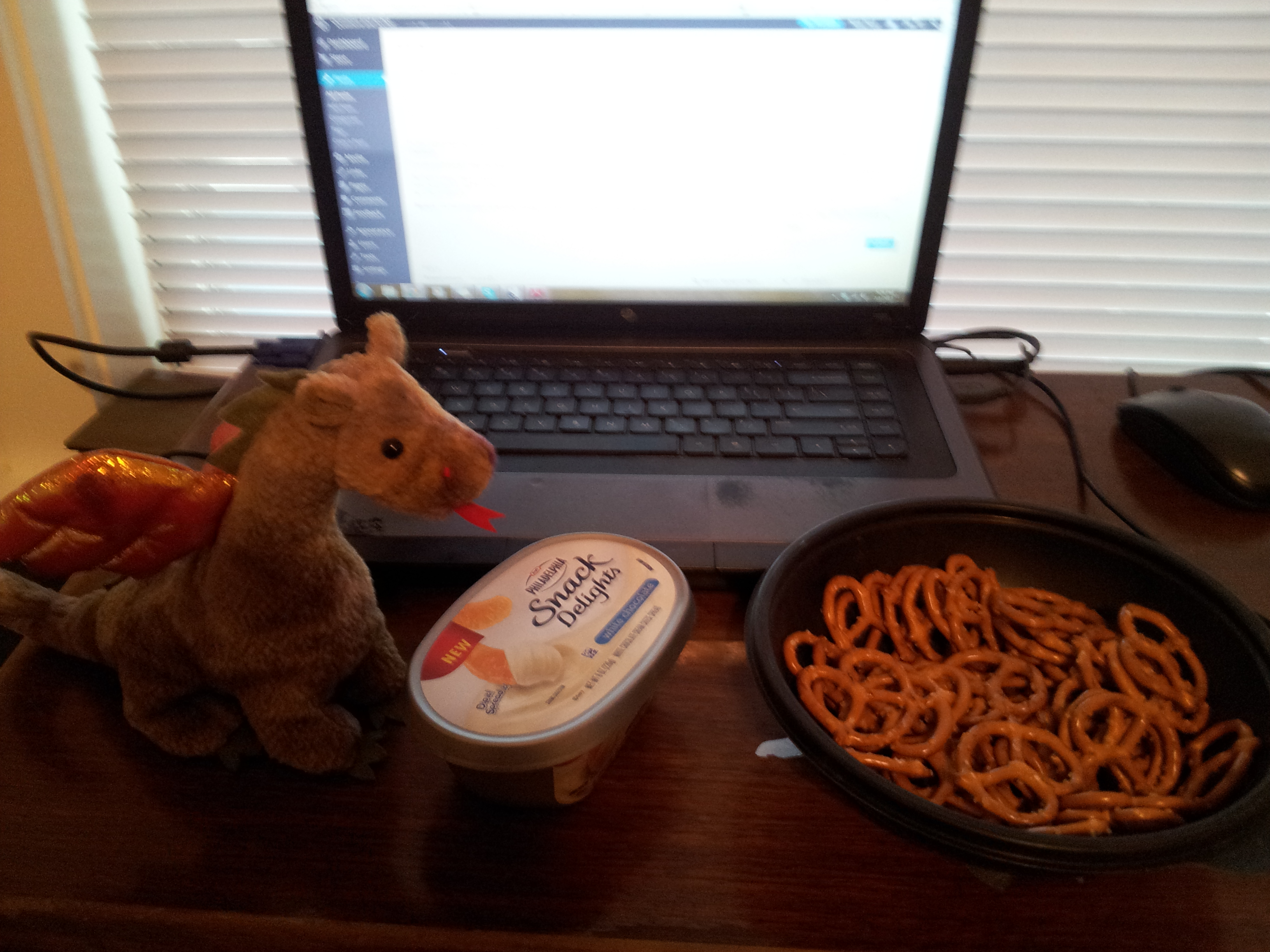
  • Laptop: check. Snack: check. Dragon: check.
    Laptop: check.
    Snack: check.
    Dragon: check.

    In lieu of participating in Camp Nanowrimo this year, I’ll be honing my blogging skills by partaking in Lesa Townsend’s 31 Day Blogging Challenge.

    I’ve got a notebook of ideas for blog posts on hand, but I fully expect my posts to get rather eclectic by the end of the month.

    But before then, I have a request for all of you, dear readers: Let me know what’s on your mind, what you want to hear about, what’s been bugging you. And if you have a post of your own that could relate (or you saw one on another writing blog), please include a link to let us know about it.

    Because you can only learn so much by reading the opinions of a single person, no matter how awesome their hats may be.

  • Map of Appalachian Trail
    In case you’re curious, THIS is the Appalachian Trail (Photo credit: Wikipedia)

    I have yet to meet anyone who’s hiked the Appalachian Trail by accident– you swear, you just stepped outside to get the mail, but 2,000 miles later you looked up and realized you were in Maine.

    That kind of hike takes preparation. You wear your most comfortable hiking boots, you check the weather, you bring supplies of food and water, you make sure you’ve got time and energy to invest in the experience. And it is an investment. Everyone I know who’s hiked the trail has spoken lovingly of the experience forever after.

    In my the same way, I have yet to meet anybody who’s ever read The Lord of the Rings by accident. Everyone I know who’s finished the book did so knowing exactly what they were dealing with when they went into the experience. And that’s because, as books go, it’s not easy. I know plenty of people who tried to tackle it, but ended up giving up before they reached the end of the first chapter. To stick with the metaphor, they tackled the Appalachian Trail while expecting it to be exactly like a romp through a city park.

    Often, classic novels are an endeavor. They use arcane language and styles that we’ve abandoned ages ago, they take forever and a half to get to the point. Plenty of people have complained about Tolkien’s infatuation with the scenery, or Victor Hugo’s love-hate relationship with pacing. While that doesn’t diminish from their beauty, it does make them difficult, especially if you’re more accustomed to modern authors and the conventions they use.

    More than a few people would argue that the beauty of the Appalachian trail would be diminished by paved roads or street lights, though they would make it safer and easier to trek, and it would make the Trail more appealing to a lot more people. Of course, the lack of people is part adds to the quiet serenity, the untouched quality of the wilderness.

    Of course, when you’re writing with the intent of being published, a lack of readers usually isn’t the end goal. Unless you run with a certain crowd, a book is no more entertaining if nobody else has read it. In fact, it could be argued that several series were greatly improved by the devotion of their fanbase. (Harry Potter is the obvious example.)

    The fact of the matter is, we read classics because they’re the books that Everybody Who’s Anybody has read– they’re on school reading lists, they’re the ones that the great authors/filmmakers/visionaries have read. But if you’re a fledgling author, you probably don’t have school reading lists and “100 Greatest Books of All Time” lists to build a fanbase for you*.

    When we talk about modern conventions– avoid filtering, use active voice instead of ‘was’ and ‘were’, employ dialogue tags that don’t distract from what’s being said— we’re talking about adding those features that make writing easier and more accessible to a modern audience. After all, unlike hiking trails, writing doesn’t lose its beauty as it becomes more accessible.

    *If you do, I’m insanely jealous of your success and deeply flattered that you’re reading my blog!

  • There’s nothing like death to add drama and angst to a story. It’s a source of grief, of guilt, of shame. What leaves the biggest scars, though, is that while the angsting character might have contributed to their loved one’s death, there’s nothing they could do to stop it once the pieces were in motion.

    Except when they can. (more…)

  • While I’m busy with grad school, I’ll be replaying some of the most-read posts from my old blog.1st person

    Some people instantly gravitate to one particular narrative style. The story they’re writing just naturally lends itself to one Point of View (POV) in particular. After all, who would want to read “That guy over there? His name is Jake,” as the intro to one of the Animorphs books? The same goes with Terry Pratchett’s stories– they just don’t work if you were to squeeze the whole story into a single person’s head.

    Other stories, though, get a bit fuzzier, and we writers can get iffy on what POV works best for what stories. Hopefully, though, I can clear up a bit of that fuzziness. 

    First Person

    This is commonly known as I. I did things, I think things, I feel things. The reader feels like they’re in a conversation with the First Person. A lot of the times stories told in the First Person read like a diary, or a story being told by a friend. (more…)

  • While I’m busy with grad school, I’ll be replaying some of the most-read posts from my old blog.

    Some people instantly gravitate to one particular narrative style. The story they’re writing just naturally lends itself to one Point of View (POV) in particular. After all, who would want to read “That guy over there? His name is Jake,” as the intro to one of the Animorphs books? The same goes with Terry Pratchett’s stories– they just don’t work if you were to squeeze the whole story into a single person’s head.

    Other stories, though, get a bit fuzzier, and we writers can get iffy on what POV works best for what stories. Hopefully, though, I can clear up a bit of that fuzziness. 

    Second Person

    This is one of the most infrequently used narrators in fiction– to the point that a lot of people have never heard of it. I’m personally not a big fan of it, but this POV does have its uses, and the things that make it difficult in mainstream fiction make it work remarkably well in areas where it’s more common. That said, proceed with caution. This particular POV is tricky at best, and has a lot of pitfalls that you can fall into if you’re not careful.
    On the positive side

    • If First Person is personal, this gets under the reader’s skin. If done well, the protagonist isn’t just some person talking to you about their adventures anymore, it is you, directly.
    • It works very well for short stories and Choose Your Own Adventure
    • You don’t necessarily have to fully develop the main character
    • If you do develop the main character, though, it can bring emotional elements up close and personal

    On the other hand

    • While this gets up-close and personal at first, if it goes on for too long at a time, the reader stops identifying the protagonist as themselves and starts replacing each ‘you’ with ‘he/she’.
    • There’s a danger of putting words in your reader’s mouth. It’s one thing for them to read about Joe Schmuck laughing as he burns down an orphanage. It’s another thing entirely to be told that you, personally, are doing so. The same thing goes in reverse– there are some people who really would burn down an orphanage while dancing in the ashes, and they’d be appalled by any allegations of the opposite.
    • The reader, being a reader, has probably read a lot. There’s a good chance that they’re pretty creative, and inevitably one of them will think of solutions that you, the writer, can’t, and get frustrated when ‘they’ aren’t taking what appears to be an obvious path. If you’re a gamer, surely you’ve seen those agonizing puzzles where only one solution works, despite the fact that by any application of logic, you should be able to do the same thing at least a hundred other ways.
    • Your tastes won’t always coincide with your readers. You might think that a voluptuous blond woman is the epitome of sexual attractiveness, but your gay male reader might get uncomfortable after a few pages of reading about ‘themselves’ lusting over her– as might your straight female reader, or possibly even your reader who vehemently prefers flat chests and red hair.

    Suggestions

    • Be short. It’s the easiest way to not worry about messing up backstory
    • Focus outward. The entire point of this POV is that you know nothing about the MC, so don’t bother describing them. Focus on the action that’s happening, and let them draw their own conclusions about how they feel and what they think.
    • If you’re going to give options, give them across the board. Do the logical thing, the thing only a complete troll would do, and something random (A favorite hobby of mine used to be flabbergasting my Dungeon Master with completely bizarre solutions to his most convoluted puzzles) and a few options in between. It’s a lot of work, but it’s a bit more organic.
    • In issues where opinions are important and polarizing– like sexual attractiveness, the likelihood of ComiCon patrons surviving a Zombie Apocalypse, etc– keep them vague. State the facts, and don’t let your own opinions lean in too much.

    Variations

    • Choose Your Own Adventure. If you don’t know them by that name, they’re the book that, every so many pages, ends with sections like “If you shake the man’s hand, turn to page 213. If you hit him over the head with a rusty spoon, turn to page 27.”
    • Roleplaying games (RPGs). Whether it’s Final Fantasy, Zork, Dungeons and Dragons, etc.
    • Short stories.
    • Epistlary and conversational stories. For the record, these don’t count, but somebody’s going to argue that when the author talks to ‘you’, the reader, it’s second person. In reality it’s usually first person, but acknowledging that second person is still in the room and giving them the occasional wink.
    • NSFW: A really creative variation on second person: The Quiet Man by IvyBlossom. John Watson is the narrator, speaking to the presumably deceased Sherlock Holmes and trying to see the world through his friend’s eyes… and that mode of narration doesn’t stop even after Sherlock arrives back on the scene. Technically this counts as a conversational story, but I have yet to find another one that takes quite this angle.
  • When you want to publish, there are generally two roads: self-publishing or going with a traditional publisher.

    A lot of people will tell you which way is best, but some things you have to decide for yourself.

  • For the December section of his “A Calendar of Tales” project, Neil Gaiman wrote a short story in which a runaway briefly meets her future self.

    (The collection of short stories is posted publicly, so you don’t have to feel guilty about reading them. Seriously, I’m in love with this collection.)

    So let’s turn this around: If your protagonist could go back ten, fifteen, even twenty years and briefly visit their past self, what would they say? What advice would they give? What would they implore their younger self to change?

    What would your antagonist say to their younger self?

    What would your characters change about their lives? What warnings would they give? Or would they say anything at all? Tell us in the comments!

  • I’ve got a weird favorite Shakespeare quote. While other people are off getting lovey dovey with Romeo and Juliet, or sniggering along with Puck in A Midsummer Night’s Dream, I’ve got a thing for Act 1, Scene 2 of Hamlet:

    List of titles of works based on Shakespearean...
    I wonder if The Bard had this particular pet peeve… (Photo credit: Wikipedia)

    Shortly after the death of his father, Hamlet’s mother remarks that he seems sad. To which he replies:

    ‘Seems,’ madam? Nay, it is. I know not ‘seems.’

    In other words: “Why the heck are you telling me I ‘seem’ sad?!? Mom, I’m in freaking mourning!”

    I often find myself quoting this particular line at people when I see the dreaded ‘seems’ in writing.

    What’s wrong with it?

    The word ‘seems’ (or any variation thereof) has a particular meaning: it appears to be one way, but it may or may not be that way.

    In writing, where the conservation of words and detail are paramount, this translates into: it appears to be one way, but it’s not.

    The problem therefore arises when somebody says that something ‘seems to be’ a nice gesture, or the dress ‘seems to be’ big enough. That ‘seems’ means that what you just said is suddenly called into question, and we’re made to expect that the opposite is true– after all, if it really was true, you would go right out and say that.

    In Hamlet’s tirade against the word, he points out that anybody can fake being sad, with dramatic sighs and dark clothes and general brooding– such people seem sad, but aren’t. On the other hand, he simply ‘is’.

    Why do people use it?

    Often ‘seems’ gets misused because

    • Writers are trying to cut instances of ‘am/is/are/was/were’ and don’t realize they’re replacing one linking verb with another.
    • Writers are trying to to point out that a character doesn’t know something– for instance, the way another character is feeling. It’s obvious that Hamlet is sad, but flat out telling us how he feels (when we’re not in his POV) would be head-hopping.

    How do I fix it?

    • Be bold. Don’t skirt around your verbs– give us strong, flavorful verbs instead. Instead of ‘Hamlet seems sad’ give us ‘Hamlet wept’.
    • Show, don’t tell. If you’re trying to avoid head-hopping, don’t tell us that a character ‘seems to be thinking hard’. Show us the physical evidence of concentration: perhaps narrowed brows, or a chewed lip. Trust us to make that conclusion on our own.

    When does it belong there?

    Not every instance of the word is an abuse of the word. Like I pointed out before, ‘seems’ can be a more subtle way of expressing irony or duplicity. It can also be used to point out something that the character legitimately doesn’t know.

    Using the dress example: it seems to be the right size, but I don’t have time to try it on. If I take it home without trying it, I’m taking the risk of being dead wrong– and then having to stay home because I have nothing to wear to the zombie ball. In this case, that uncertainty would cause tension. Used too often, though, and the tension drains out and the narrator just seems wishy-washy.

  • Elizabeth stares at an unfamiliar sight after ...
    Elizabeth of BioShock Infinite opens a tear into another timeline. (Photo credit: Wikipedia)

    You already know I’m into Bioshock Infinite, as well as Fringe and the Star Trek reboot. Apart from all being some pretty fun Sci-Fi, all three deal with different timelines and realities. (You’ll also find Ursula K. LeGuin’s The Lathe of HeavenRay Bradbury’s A Sound of Thunder,  and Terry Pratchett’s Jingo on that list).

    It’s a common enough theme in Science Fiction– you see it almost any time you deal with alternate dimensions and time travel– but here’s the refresher:

    We think of reality as a system of cause and effect (though I understand The Doctor begs to differ), and so where we are now is the result of our choices in the past. If we’d made a different choice somewhere in the past, we’d be somewhere else entirely.

    So where would we be if we’d made different choices? Or more specifically, where would our characters be?

    This is a writing exercise I’ve been using to keep from getting getting off-track in my current story. It helps to keep me from burning out or getting off-track on the existing plotline, but it also forces me to think about the world and the characters on a different level.

    Most of these I don’t write out in their entirety– not full of prose and dialogue– but rather as a synopsis. I follow the characters from one event to another and see where they go. I’m always adding to this list, but so far it includes What Ifs such as:

    • What if the Villain’s plot goes exactly according to plan? What does that original plan look like, every step of the way? What does the world look like when he’s finished with it? How has he changed by the time he’s finished? Is he any happier for it?
    • What if the Star-Crossed Lovers had never met (okay, so this one was pretty boring for me: they would keep going in the direction they had been at the start of the story. More interesting, in this case:)
    • What if the Star-Crossed Lovers had gotten together, but then decided to break up? What would it take to make them decide on this? How do they go back to living alone once that interdependence has been established? How much did each partner affect the choices of the other? (Playing all the way through this really flipped my expectations of the power dynamic between these two, and gave me a much more intimate look into their respective needs and personalities.)
    • What if the Prisoner hadn’t had to save himself? What if he’d been rescued instead? (This one had the biggest ripples– within a year of that event, the entire world is unrecognizable.)
    • What if the Heroine had chosen a different way of dealing with her problems?

    What writing exercises do you use to explore your world? Have you tried this one– and how has it worked for you? Tell us in the comments!