Hey all,
Less exciting post this week, because I’m out with Covid.
Remember: mask up if you’re feeling under the weather, and don’t forget to keep up to date with your vaccines!
Home of JW Troemner and Urban Dragon
I’ve got a whole little collection of snippets and short stories from the world of Urban Dragon. One of the things that I’ve always wanted to explore but never got a chance to were the Doors to Nowhere in the Forest of the Damned– those prototypes that don’t lead to anywhere in Arkay’s world. Some of them, as it turns out, don’t cross space so much as they cross time.
That’s where this story comes in.
Meeting your past self, Arkay decides, is weird.
Like, really weird.
Zero out of ten, would not recommend– like those fucking awful mixed drinks that some people recommend on a dare, the ones that are endured and survived and then passed along like a sixty-proof curse.
In fact, she might just prefer the Red-Bull-and-Sour-String right now, because that hangover was starting to sound like a cakewalk compared to the headache she’s getting just looking at ThreeClaw.
For one thing: the whole age thing. Because technically speaking, ThreeClaw is a whole lot younger than her right now– maybe fifteen, twenty years, it’s hard to pin down exactly when this is happening and she’s already promised to leave years out of it– but she looks older. Not older as in the eighty-or-whatever years that she actually is, of course. There’s something weirdly ageless and statuesque about her, no wrinkles, no loss of elasticity, no slow shift in muscle or fat distribution, no scars apart from the missing arm, but there’s a rigidity to her posture that flat out declares she’s never seen the broad side of a stripper pole, a hardness to her eyes, a stiffness to her face like it might break in half if it ever cracked a smile.
But under those flinty eyes are her cheekbones, and between them is her nose, and that’s her jawline alright. And okay, the scalp is weird– leave it to the buzzkill to wear a buzzcut– but Arkay gets a good look at it, because the two of them are the exact same height.
ThreeClaw is fixing her with the same cold appraisal, and she doesn’t seem to like what she sees any more than Arkay does. Which is fine, Arkay’s fielded enough judgy looks that it doesn’t bother her– it’s just that most of them don’t come from the other side of a funhouse mirror.
It’s weird, is what she’s saying.
“You aren’t a doppelganger,” ThreeClaw says at last. Her voice is low and level, and there’s the faintest hint of an accent woven into it– Northwest, maybe?– but otherwise it reveals nothing.
“If I was, I’d be the best fucking doppelganger you’ve ever met.”
“Or the worst.”
“They never get the smell right.”
“You smell nothing like me.”
“That’s because I actually use shampoo. And bodywash. The nice stuff, not– what even is that, gas station soap? You’re rich as a gilded age porn star, and that’s what you’re using? Seriously?” She takes a breath to calm down and get back on track. Meanwhile ThreeClaw’s expression hasn’t changed in the slightest. Nothing about her has changed. She hasn’t moved a muscle, except to breathe: again, statuesque. “Besides, you know as well as I do that that shit is superficial at best.”
“I’m sure you’re the expert in that field.”
Arkay chooses to let that go. “The important stuff, though? The baseline stuff? You can’t copy that just by raiding the bathrooms of the nearest Love’s. You smell like dragon. We both do. The right kind of dragon. And that’s not something you can fake.” She rolls her eyes. “Also there are a few key details that I’m pretty sure most doppelgangers would be paying more attention to.” She waves her conspicuously present right hand.
That hand is what sells it, really, because it tells the story all by itself: that someday ThreeClaw gets so fucked up and takes so much Styx that she regrows the missing limb from scratch, which suggests that there’s not much of her original brain left inside her skull. Ipso facto: an identical dragon with an identical face who doesn’t look like she got an assault rifle shoved up her ass. And then apparently got her left arm blown off sometime later, but these things happen.
“Look,” Arkay says. “I’m sure it comes as a great disappointment to you that this right here–” she gestures between the two of them, “is actually not some weird sex thing. Which, your loss, but that’s beside the point.”
“So you do have a point, then.” ThreeClaw raises one eyebrow so masterfully that she must have practiced that look in front a mirror for hours.
“Yes.” Arkay says. “My point is– Styx. You have it. I need it.”
ThreeClaw’s eyes move deliberately to the scars exposed by Arkay’s neckline. They look older than they should be, but if she was regularly dosing, they’d be as flawless as ThreeClaw’s skin.
“You had it,” ThreeClaw muses. “Whatever happened to your supply?”
By which she means: what happened to her supplier. But Quinn is long gone, and with him any chance of making more.
“It’s gone. Or so close to gone that it’s not going to last us to the next emergency, and we need more. Which is why I’m coming to you, on this the day of your daughter’s wedding–”
Clearly ThreeClaw has no patience for movie quotes. “You want to know how to make it.”
“Fuck no,” Arkay says. “Are you kidding? Have you looked in the mirror lately? Have you seen what that shit’s done to your soldiers? People aren’t meant to squeegee their insides off the floor and then turn around and go back to the front lines the next day. And an endless supply is going to just open that back up.”
ThreeClaw tilts her head, which is about as good as a paragraph coming from her. “So you want a limited supply.”
“Yes. What you can spare.”
“My stockpile.”
“It’s not like you can’t make more.”
“We need it. There’s a war on.”
“So I’ve heard.”
Another head tilt. “But there isn’t. Not for you.”
Okay, so that probably violated some rules of time travel or whatever. Assuming this even is time travel and not some weird parallel dimension shit, which is a whole other pile of headaches that Arkay does not need right now. At least she didn’t say anything outright: just implied that the mental wellbeing of her soldiers is a priority rather than the whole not-going-extinct thing, which in turn implied some kind of big things about the way the world works in the future.
“You know I can’t tell you about that,” Arkay says.
“Can’t you?”
“No. Because wibbly wobbly– never mind, I don’t even know if that’s come out yet. But you know how this works. I can’t just give you the cheat codes to fix the future. It doesn’t work like that.”
“But you expect me to give you the cheat codes to life itself, entirely gratis.”
“I mean, technically you’d be giving it to yourself. Because, you know.” She waves her hand between the two of them. “And we’re helping your people here. That’s got to mean something, right?”
“It really doesn’t.” ThreeClaw levels her stare. “You want this. Then give me something in exchange. Something worth having.”
Arkay just stares. What’s she supposed to say? Without a relevant year, it’s not like she can give any kind of investing advice. Pass along the names of some politicians to keep an eye on, maybe? Tell her about this Order kid named Adam– make sure he stays alive, but apparently your people kill his parents anyway so they’re free game? Tell her what year she stops being ThreeClaw so she can quit sneaking off looking for creative ways to die?
And she raises her eyes to meet ThreeClaw’s unyielding stare.
“Nadia still misses you.”
If she wasn’t already looking for it, she never would have noticed the way ThreeClaw goes absolutely still. For several long seconds she doesn’t even breathe. The only hint that thoughts are racing behind those eyes is how absolutely they’re shuttered, perfectly trained to be perfectly blank.
You don’t work that hard to hide something unless it matters.
Which means it’s a choice when ThreeClaw slowly shuts her eyes. It’s a concession– I know that you know that I know that you know– but she’s still too heavily guarded to put it into words.
Not that, at least.
“On the southernmost wall of my living room, I am going to install a false wall. Behind the wall will be a door. On the other side of that door will be a stockpile. That door will be the only entrance or exit. No one else will know it exists. No one will be able to add to or draw from it once the wall is installed.”
Arkay frowns. Really, she’d been expecting to get handed a bunch of crates or something– but then, that would risk somebody seeing and asking awkward questions about the world’s worst ThreeClaw cosplayer, which might invite other questions that might lead to some uncomfortable paradoxy shit. So she asks, “Do those things expire?”
“I suppose you’re going to have to find out.” The transaction finished, ThreeClaw turns and begins to walk away. She only falters briefly, a blink-and-you’ll-miss-it hitch in her step, but Arkay is still watching.
“Yeah,” she says to the unspoken question. “I’ll make sure she’s okay.”
ThreeClaw’s jaw jerks in a hint of a nod and she keeps walking, never breaking her stride.
Arkay watches her go. It isn’t until ThreeClaw is completely gone that she lets out the thought she’d been holding in.
“Was nobody going to tell me my ass was flat?”


So what lured me down this rabbit hole in the first place?
If you know anything about me, you’ll know that most of my thoughts either start or end with writing.
My most recent book, the Dealmaker’s Gambit, takes place in the world of Koleth– and that world is built largely on a foundation of constructed languages.
One of the main characters of that story, Zag, belongs to a supernatural group of people known as the Zader— at least, that’s what they’re called some of the time.

See, Dealmaker takes place primarily within the borders of the Remishi Alliance, a coalition of nations united by a common primary language. But there are other countries in this world. Kiha, another main character, is originally from Mata and natively speaks Abuian. Meanwhile another story I’m working on in this world begins in the nation of Zakilu, where the primary language is Situ.
People like Zag exist all over the world of Koleth, and have for as long as there have been people in those places– and so, each language has its own word to refer to them. For simplicity’s sake I avoided getting into the weeds of it all with Dealmaker with little trouble, but with this new project, I’m finding I can’t put it off much longer.
So what do I call people like Zag, and what does it mean if I do?
In Remishi, Zag would be a Zader, meaning gentry or nobility— it’s a term that calls back to the Remishi people being subjugated by powerful Zader (“those political assholes,” as Zag refers to them), who created a hierarchy that put themselves at the top, prompting a violent revolution that toppled the previous regime and put humans on top. And in light of that history, what once was a term of deference has become something very close to a slur.
Meanwhile the Situ people have a decidedly more neutral relationship with the same group of people. Their word for them is Shikna, meaning merchants, and their role is often to linger on the fringes of society and trade in magic to give the people what they want or need– but always for a price, and with little sympathy for quibbles like buyer’s remorse. Like many of our world’s traditions about faeries, genies, and witches, the Shikna are beings to be treated with caution and respect, and preferably with a lawyer present.
For the sake of simplicity, I put some serious thought into nixing Shikna as a term and using Zader instead, no matter the setting. Which got me thinking.
See, the Remishi Alliance is in many ways imperialistic. As much as they insist that they stay within their borders, they push their hegemony on the nations around them. And that eagerness to export their culture is baked into their interactions with the people who have to deal with them– their trade regulations which dominate the sea, their fashions which aren’t particularly practical in other regions, their systems of government, their philosophy and morality, even their calendar. And given all of that, there’s something downright insidious about using a slur to refer to a powerful and capricious being just because the term is popular a few countries over.
It’s fraught, and it’s fraught in a way that people in the real world deal with every day. I can’t even begin to cover the sheer breadth of the complexity of the issues at hand on my own– entire books have been written on the subjects by people far more qualified than me– but I’d like to at least be able to acknowledge that it’s a thing, and do so thoughtfully and with intention.
This is the last installment of a four-part series on choosing names and why they matter.
Part 1: A Person by Any Other Name
Part 2: Politics of Place
Part 3: A Take on Taxonomy
Part 4: Imaginary Worlds


So here’s a question: why are animals called what they are?
I’m not talking about the big categorical names– things like ‘dog’ and ‘cat’ and ‘horse’ go back for hundreds of years, according to etymology. But when you want to get more specific than that, things get a little wonky.
Let’s talk fossils and dinosaurs: if you’re thinking about the long-necked behemoth, LittleFoot from Don Bluth fame, you’re probably thinking about a brontosaurus– except, as pedants in any natural history museum used to be quick to tell you, brontosaurus didn’t actually exist.

According to an article by Emily Osterloff on the Natural History Museum website,
“The first recorded evidence of Brontosaurus was discovered in the 1870s in the USA. But by the early 1900s, scientists had started to question whether the fossils used to name Brontosaurus actually came from another dinosaur, the remarkably similar Apatosaurus.
Due to the rules of scientific naming – the first name published gets priority – Brontosaurus was relegated to scientific history and the fossils reassigned to Apatosaurus.”
But remember that I said pedants used to be big on this subject? Turns out, even fossilized facts are subject to change. Osterloff continues:
“That was until a study in 2015 unexpectedly found evidence that Brontosaurus was distinct from Apatosaurus all along, signaling the reinstated status of this iconic dinosaur.”
This plays on an established rule in the paleontological world: the earliest name for the fossil is what gets to stay. And that’s all well and good for creatures whose existence predates humans by eons.
What about the ones that are living side-by-side with humans?
Here’s where things get political again, particularly when we talk about species native to colonized places.
The thing about colonizers is that they tend to suddenly come into contact with a lot of unfamiliar things. Sometimes they’ll ask the indigenous peoples of the area what the heck those weird-looking animals are called (where we get words like condor, kangaroo, and koala, from Quechua, Guugu Yimidhirr, and Dharug, respectively). Other times, they’ll either neglect to ask the name or ignore it altogether, and instead refer to it as something similar they remember from home, as is the case with robins. According to Kenn Kaufman at Audobon.org:
“When English-speaking explorers and colonists began traveling the world, they applied the name Robin to anything that reminded them of the familiar bird from home. Our American Robin really isn’t similar, aside from having orange on the chest; it’s twice the size and four times the bulk of the European bird, and these days it isn’t even classified in the same family. Neither are the Australasian robins (family Petroicidae), more than 50 species of small, sharply patterned birds found from New Guinea to Australia and New Zealand. Various robin-chats in Africa and robins in Asia are at least placed in the same family as the European Robin, but they’re not all closely related. But none of that really matters; it’s a good name, and we can sort out any possible confusion by looking at the scientific names.”
And other times entirely, the species they come across are named to honor someone and something. And as with place names, the choice of who gets honored by that kind of name can be fraught.
Take for example the ʻaoʻū, previously called the Christmas shearwater, a bird native to the shores of Hawai’i– the defunct name seems rather bizarre, considering that Christmas was a tradition that was completely nonexistent in Hawaii before the late 1700s. Meanwhile the current name ties into the language and traditions of the Hawaiian people, and is itself descriptive: According to a press release from the Office of Hawaiian Affairs, “The name ʻaoʻū was chosen for the Christmas shearwater based its call, where the sound ʻao is repeated six times followed by a long ʻū sound. “ʻAo” means a new shoot, leaf, or bud, especially of taro, and “ao” also refers to clouds, the light of day or daylight as well as enlightened; to regain consciousness. ʻŪ means to growl, grunt, groan, moan, sigh, hum, coo; to hold the breath. Naming birds from their sound is a common practice for many sea and shorebirds in Hawaiʻi.”
Another push toward decolonizing birds in particular has come in the wake of a highly publicized 2020 incident involving birdwatcher Christian Cooper, which sparked conversations about racial bias and its intersection with the (stereotypically very white) field of birdwatching– and in this case, how discouraging it can be for birdwatchers of color such as Cooper to realize just how many of the birds they love are named for slaveholders and white supremacists.
The Ad Hoc Committee on English Bird Names for the American Ornithologists’ Union is opting to move on from person-based naming conventions entirely and move toward more intuitive and descriptive names. “They imply possession of a species,” explained committee co-chair Erica Nol, who went on to point out the intrinsic bias within those names that are given: “They are overwhelmingly from a particular time and social fabric, they are almost all White men, few women, and women were almost all first names.”
There’s some pushback, of course– like with places, there are a lot of people pointing to history, and to habit, and to the inconvenience of renaming these creatures.
But in the end, what we call a thing is a choice, and what choice we make speaks volumes about what we value.
This is the third installment of a four-part series on choosing names and why they matter.
Part 1: A Person by Any Other Name
Part 2: Politics of Place
Part 3: A Take on Taxonomy
Part 4: Imaginary Worlds


How do you refer to the island nation in the Pacific Ocean, roughly around 41* S, 175* E?
In 1642 it was named Staten Land by Dutch Explorer Abel Tasman, in 1645 Dutch Cartographers renamed it Nova Zeelandia in reference to a Dutch province, and “British explorer James Cook subsequently anglicized the name to New Zealand.” (NewZealandVacations.com)
But if you ask a whole lot of people– particularly the people whose ancestors lived there before the Dutch came around– they might instead refer to it as Aotearoa, which is a name being pushed for with greater momentum in the last several years thanks to the efforts of Māori activists, with many around the world starting to adopt Aotearoa New Zealand to refer to the land. Though even that name doesn’t tell the whole story.


I’ve been doing a lot of pondering about names. How they change, how they represent us, where they come from and why.
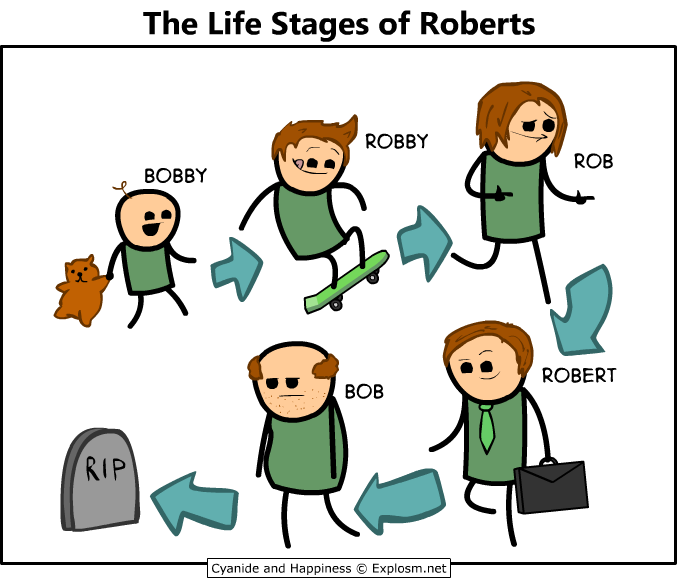
Cyanide and Happiness has a great comic titled The Life Stages of Roberts, about how a single name carries completely different associations and how that can change throughout a person’s life.
People in the LGBT+ community are well acquainted with the way people can be uplifted or protected or harmed by the names others choose to use for us. For a well-known literary example, I like to point at the protagonist of Victor Hugo’s Les Miserables, a man of many names:
he was born Jean Valjean, a family name shared by a really delightful number of his relatives
Upon being imprisoned in the bagne, he was designated Prisoner 24601, meant to rob him of his personhood
But the other prisoners called him Jean le Cric, or Jean the Jackscrew, because his impressive strength
In Montreuil-sur-Mer, he constructed a new name and identity as Father Madeline (itself a reference to Mary Magdalene, and all the Biblical allusions that entails), in an attempt to escape the crushing stigma of being an ex-convict
Then when he was re-arrested and given a new designation: Prisoner 9430 (which, alas, doesn’t go to music nearly as well as his more famous number)
Upon his escape he takes shelter with a friend from his past and assumes the identity of the friend’s brother: Ultime Fauchelevant, which provides him safety
Except when he’s held hostage and made to send a note under duress by villains who only know the initials of his assumed name, so he signs it Urbain Fabre
While at Paris he’s also sneaking around anonymously giving out gobs of money to the poor while dressed in rags, earning himself the name The Beggar Who Gives Alms, while also using the name Leblanc as an alias
At this point he’s also adopted a daughter, who calls him Papa— until he makes the choice to distance himself from her for her protection, and insists that she only refer to him as Monsieur Jean
Each of those names carries vastly different contexts and meanings. Some of them signify respect, some derision, some are shields to protect him from scrutiny, some are weapons used to hurt him. And that’s just a single character in a single book.
This is the first part of a four-part series on choosing names and why they matter.
Part 1: A Person by Any Other Name
Part 2: Politics of Place
Part 3: A Take on Taxonomy
Part 4: Imaginary Worlds


It’s been a long time since the wonderful podcast 60 Second Saga was discontinued, but I only recently realized that I never had the chance to post my second submission: here’s a beautiful rendition of my short story, Between the Particles.


Hello again. Did you miss me?
I’ve had some pretty major upheavals in my personal life these past few years, but now that I’m finally starting to get my feet back under me, I think it’s time to dust off the old website, give it a fresh coat of pixels, and try to get back into the swing of things.
And what better time for a fresh start than the beginning of a brand new year?
I know a lot has changed since I’ve last been active– Twitter is now X, BookTok is all the rage, and on and on– so I’ll be learning as I go, and any gentle advice and input on sites to investigate will be greatly appreciated.

I’m one of those proud nerds who loves looking at a map when I open a book. So when I created the world of Koleth, of course I wanted to include maps.
Koleth was built from below the ground up– by which I mean, I started with plate tectonics on a globe and worked my way up. Which is how I got this delightfully messy world map over here:

From there I added some national divisions, etc:

(Ignore the massive poles– map projections can be tricky that way).
But all that’s way too much information to include on a map for this one story. So I zoomed in a bit, lightened it enough so I wouldn’t murder my printer, and added the locations I mention in the Dealmaker’s Gambit.

And then traced over that with a good old sharpie and some highlighters (it was a slow day at work.)
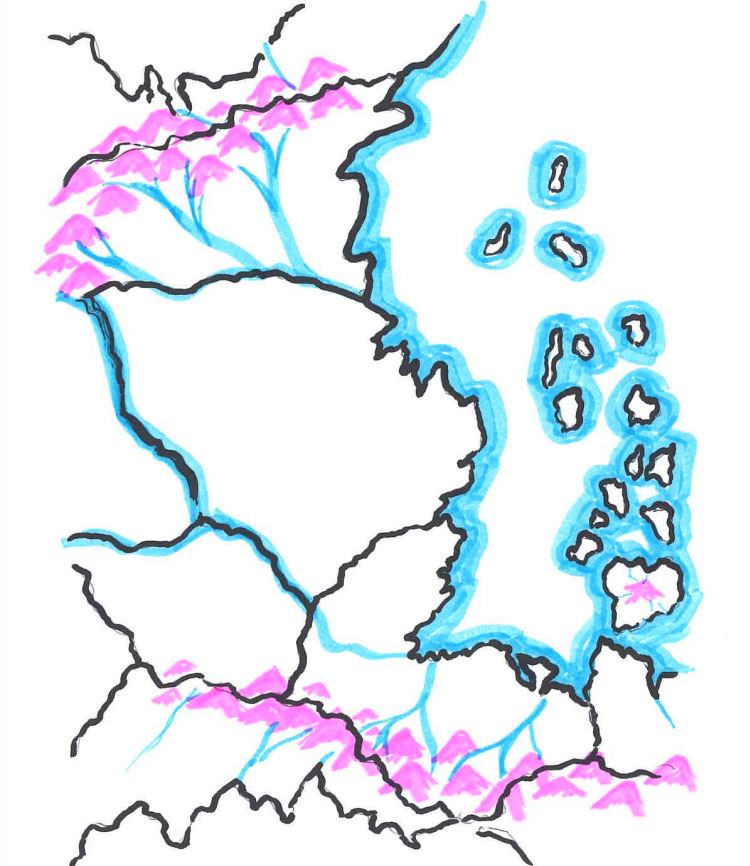
After that it was a matter of cleaning it up in photoshop, adding some text, and voila!

That looks like something that you might find in a book!


First off: I’m nonbinary.
I’ve identified as nonbinary for years, and it’s never exactly been a secret.
For those unfamiliar, nonbinary can be a little bit confusing, because it’s the equivalent of checking the box that says “other” instead of “mr” or “ms”. It means I don’t fit neatly into the female-ness I was born into, or the male-ness that I assumed was my only alternative. And it’s confusing because every nonbinary person is going to have their (or indeed his or her or xir, etc) own experience with and relationship to gender. It’s as broad a category as “non-English speaker” and “non-bird”– there’s a whole lot that that can include. So with everything that follows, please understand it’s my experience, not one that speaks for all trans or nonbinary people.
For me, that means I generally use “she/her” pronouns to save time and energy; “they/them” are fine, too; “he/him” is amusing sometimes, but there’s no dysphoria or insult attached to it.
When I present, it’s generally in a fairly “neutral” way– t-shirt, jeans, no makeup, bra sometimes, shoes from the men’s section. These days that’s considered generally normal for women’s fashion; decades ago, I’d be a weirdo trying to dress like a man. Turns out clothes aren’t gendered. More on that later.
In the past, I’d tried wearing makeup, but I always felt like a clown. When I wore skirts, I felt like an impostor– one who wasn’t fooling anybody. When other women would talk about their experiences, I was at a loss. My experience was nothing like theirs. Constantly I felt like I was Doing It Wrong. Like every step I took, every word I said, every breath and thought was an error. The harder I tried, the more Wrong I felt.
And I did my troubleshooting– maybe I was just really bad at makeup? But when it was put on me by professionals, it still felt wrong.
Maybe feminine clothes all felt wrong on me because I didn’t have the “right” body type? I bought dresses made specifically for me, and it felt the same– like a weird costume meant for somebody else. Even attempts to “girl up” in small ways wound up feeling false.
Some have argued that the real culprit was a misogynistic society: that to be a woman is to be uncomfortable, to feel ugly, to be an impostor. If I disliked feminine things, they said, it was because of internalized misogyny, or because of impractical standards set for women. And come on, everybody hates seeing themselves in photos.
So I wrestled with body positivity. I found every single aspect of myself and looked at it, really looked at it, on other women. I studied the way the parts added up to a whole– how every aspect of the person in the mirror was reflected so beautifully on the people around me. I loved the looks that other people put together with hair and makeup and clothes. So why did it feel so right on them and so wrong on me?
For a long time I just let that be the background radiation of my life: that constant feeling of Doing It Wrong.
Looking back, I realize that feeling is called Dysphoria. According to the American Psychiatric Association:
Gender dysphoria involves a conflict between a person’s physical or assigned gender and the gender with which he/she/they identify. People with gender dysphoria may be very uncomfortable with the gender they were assigned, sometimes described as being uncomfortable with their body (particularly developments during puberty) or being uncomfortable with the expected roles of their assigned gender.
Kinda vague, isn’t it?
I’d heard of dysphoria in those kinds of terms– and with it the narrative of The Surgery, and the reflexive disgust when presented with one’s own anatomy, etc, the desperate need to be the “opposite” gender. But I didn’t want anything in those terms.
I spent some time thinking about it: do I want to be a boy? Do I want surgery? Do I want hormones? And resoundingly, the answer was no.
The term “nonbinary” was tossed around occasionally, but only as a vague idea, and only ever as a strict androgynous entity that used “they/them”. Do I feel my skin bristle when I’m called “she”? Do I prefer “they?”. Also no.
But then I started talking to more people and listening to more stories, I started noticing elements that resonated with my experiences and my feelings. And then I started learning that you can be androgynous-leaning-feminine or girl-and-sometimes-boy or “meh”. I learned that you can be a “she” but not a woman.
I took what was presented to me in those stories, and I tried that on for size. I put on the label “nonbinary” for a bit, and let it sit with me. And it felt right in a way that nothing had for a very long time.
A lot of my previous Wrongness started falling away. I stopped reflexively hating pictures of myself. I started feeling calmer, and it became easier to manage my temper. Without the thought of “what is she doing right that I’m doing wrong?” scraping at my mind, I found myself celebrating the women around me more often and more genuinely.
And here’s the other thing: as I got comfortable thinking of myself as nonbinary, I got a whole lot more comfortable with the rest. Dresses no longer feel like costumes, makeup no longer feels clownish, heels– well, heels are still hard to walk in, but that’s got more to do with my dexterity. Before, any attempt at femininity felt like a miserable impersonation of the woman I couldn’t actually be. As I am, there’s no more pretending. The clothes I wear aren’t a disguise, but just the things I wear when I feel like it.
It’s a feeling of rightness. Of being at peace.
And that’s really, really nice.
Maybe my narrative will resonate with some part of you. Maybe seeing one experience will make you think harder about your own. Maybe you’ll think about trying something new, or maybe you’ll find that you’re even more confident in where you stand right now.
May you find the best version of yourself, whatever that turns out to be.


 JWTroemner.com