Tag: the dealmaker’s gambit

  • A funny thing happened this weekend at Indiana Comic Con. Two of the people who came to my booth– both of them younger, neither of them readers of mine before this– mentioned having seen and heard of my books before. Not at previous conventions, or at libraries, or bookstores, or in someone else’s hands, but online. Either on Facebook (an ad? or a reel?) or on TikTok, it wasn’t super clear in either of their minds.

    Which is kinda odd. Because I don’t have a TikTok (a written blog is more than enough for me, please) and it’s been a very long time since I’ve bought ads on Facebook, and I’ve never paid to promote my page.

    So where did these people see my books?

    A few theories present themselves:

    1. Someone read one of my books and posted about it. Which would (hopefully) be awesome, and if that’s the case I’d love to get a link so I could share the video.
    2. Facebook decided to recommend my Facebook page to people unpaid. This would be appreciated, but kinda weird– famously, page owners have to pay big bucks to have Facebook show their post to a greater percentage of their own followers. Spreading the word of my books gratis seems uncharacteristically generous.
    3. It wasn’t my book they saw, but an unrelated one with a similar cover. This seems the most likely to me. Most covers available to authors in my income bracket are made by digital artists creating a composite image out of a number of licensed stock images. That isn’t an exclusive license, and so the same image and can wind up being used by multiple artists for multiple projects– especially if it’s a particularly distinctive one that leaves an impression.

    It doesn’t stretch the imagination that the image of a young woman surrounded by burning pages might work thematically for other books. Which is why I’m guessing that some other author might have promoted their own book, and unwittingly gave me a leg up as well.

    Whatever the cause, it’s a neat little mystery, and one I’d love to see solved.

  • Ordering books just before a convention can be tricky. You never know when there’s going to be inclement weather, production mishaps, or just plain bad luck at play, so the process of waiting for the shipment to arrive is always just a little bit nerve wracking.

    And with Indiana Comic Con happening this weekend, I was biting my nails.

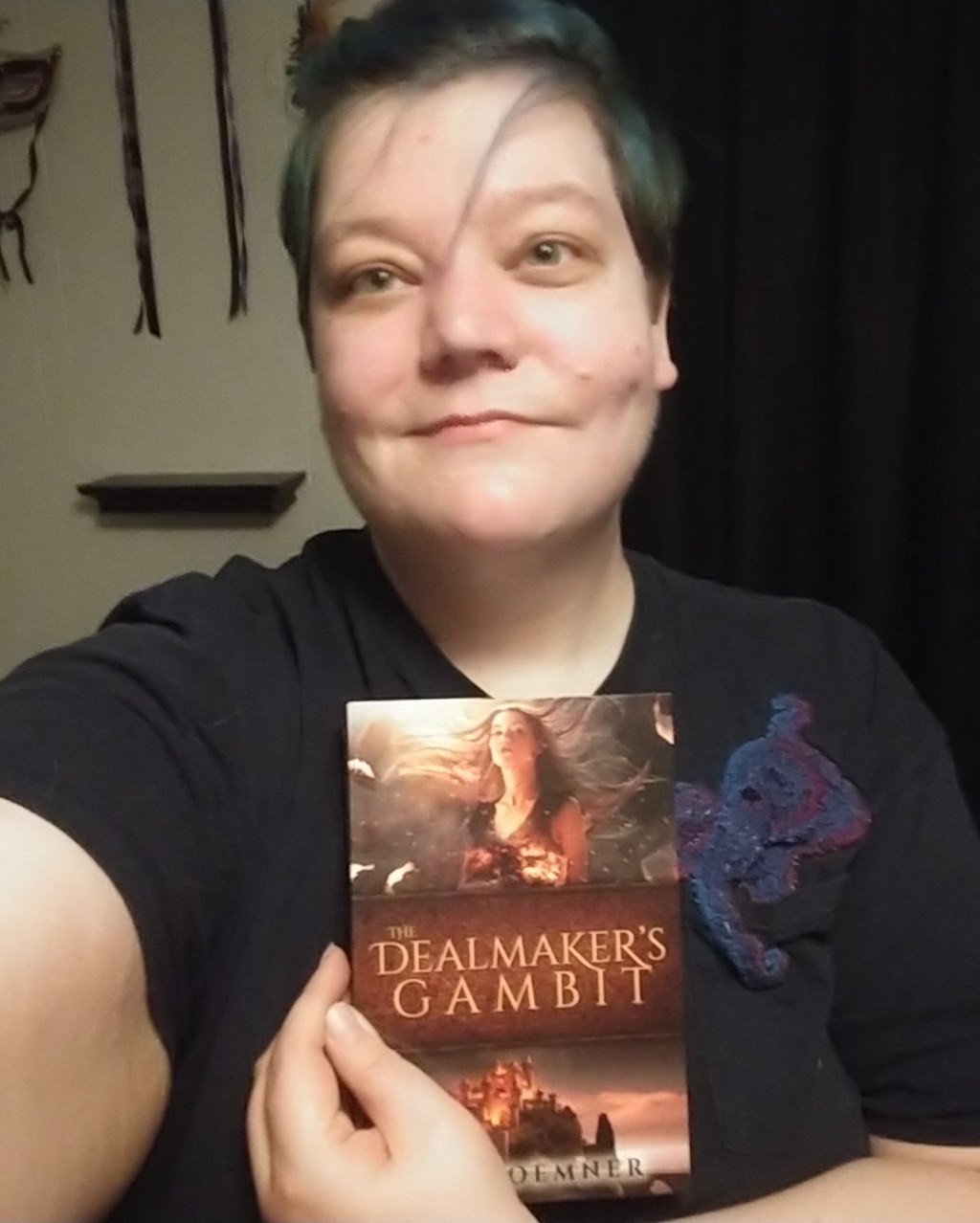
    So you can imagine my relief when I found these on my porch!

    That’s one less thing to stress about before I get all loaded up for the con!

  • There was a subplot in the Dealmaker’s Gambit that had to be cut because I just couldn’t get it to gel the way I wanted it to.

    The TL;DR was that Irora had Zag make a number of talismans into peppercorns and plant them in high-end restaurants, resulting in a number of wealthy civilians (and one seagull) getting arrested as dealmakers. It was a bit of chaos and comedy, and a glimpse into the way that laws are unequally enforced among classes.

    Below are the outtakes of what I had written of the saga.

    (more…)
  • I don’t often write while listening to music, but I do use music to get me in the right headspace to start writing.

    A few highlights:

    Child of Ashes by Madds Buckley

    The vocal quality of this piece is what I have in mind when I think of Zag’s voice, and the lyrics put me in the space of those early encounters before Zag and Irora got comfortable with each other.

    Child of ashes and child without home
    Where will you run, in the night?
    Child of broken flesh and bones
    Where will you go to hide?

    Heroes won’t help poor folks like you
    Blood on their hands, dust in their shoes
    Heroes will hunt you and lead you astray
    Don’t cry now my child, here you can stay

    Safe in the arms of those who know that you deserve a place
    Safe in the hands of those below
    We can watch the world decay

    The Devil Within by Digital Daggers

    This is very much Irora and her revenge, particularly her in opposition to the Commander.

    I made myself at home in the cobwebs and the lies
    I’m learning all your tricks, I can hurt you from inside
    I made myself a promise you would never see me cry
    ‘Til I make you

    Take Him Away by the Dirt Poor Robins

    Every time I hear this song I’m thinking of the trial and interrogation scene when Rinvu is first introduced– particularly the awareness of the person standing behind the judge’s podium of just how far removed this situation is from actual justice.

    Take him away
    I’ve washed my hands and I cannot be blamed
    No I will not be liable for his final fate
    He will not find justice here today

    Irony by the Dirt Poor Robins

    There’s a surprising amount of Dirt Poor Robins in my playlist, actually. This one speaks to me of the Commander and the way she’s tied her morality into knots trying to justify herself.

    This pride has left you blinded or willfully confused
    You thought that when you cried for justice, the target wasn’t you
    Yet in the end your fatal flaw, the measurements were wrong
    For you saw the sins of others, as greater than your own

    Going Down Fighting by Andrewa Wasse and Phlotilla

    Going Down Fighting always puts me in the mind of Irora surrendering to Rinvu. Even before she arrives at the gendarmerie, even with all the plans she and her friends have made, in the back of her mind she knows is going to blow up in her face– and she goes anyway. This more than anything else is her defining choice in the book, and it’s the one that hits her hardest with consequences.

    If the city’s on fire
    I’ll stand in the ashes
    There’s no turning back
    It’s ready or not
    So I’ll fall to my knees
    And pray for the masses
    ‘Cause this world
    Is all that we got

    (Also: there was a version of this story where the Commander lit the city on fire in order to sway public opinion to her side. That subplot got scrapped, but the vibe of it was still with me when I stumbled on this song.)

    Ashes by the Longest Johns

    This is very much a Kiha song. They are the beating heart (and let’s face it, the mental stability) of this story, and this song really carries the memory they carry with them, and the aged grief that comes with it.

    Do you feel heavy? Your eyes drop with grief
    Your spirit is wild and your suffering is brief
    So never you buckle and bend to the masses
    I’ll tend to the flame; you can worship the ashes

    And a special mention:

    What Love Can Heartbreak Allow by Ben Caplan

    When I think of traditional Mataan music, it sounds like this: a round/perpetual canon in which multiple verses are layered on top of one another.

  • So what lured me down this rabbit hole in the first place?

    If you know anything about me, you’ll know that most of my thoughts either start or end with writing. 

    My most recent book, the Dealmaker’s Gambit, takes place in the world of Koleth– and that world is built largely on a foundation of constructed languages. 

    One of the main characters of that story, Zag, belongs to a supernatural group of people known as the Zader— at least, that’s what they’re called some of the time.

    Tales of Koleth: The Dealmaker’s Gambit

    See, Dealmaker takes place primarily within the borders of the Remishi Alliance, a coalition of nations united by a common primary language. But there are other countries in this world. Kiha, another main character, is originally from Mata and natively speaks Abuian. Meanwhile another story I’m working on in this world begins in the nation of Zakilu, where the primary language is Situ. 

    People like Zag exist all over the world of Koleth, and have for as long as there have been people in those places– and so, each language has its own word to refer to them. For simplicity’s sake I avoided getting into the weeds of it all with Dealmaker with little trouble, but with this new project, I’m finding I can’t put it off much longer.

    So what do I call people like Zag, and what does it mean if I do?

    In Remishi, Zag would be a Zader, meaning gentry or nobility— it’s a term that calls back to the Remishi people being subjugated by powerful Zader (“those political assholes,” as Zag refers to them), who created a hierarchy that put themselves at the top, prompting a violent revolution that toppled the previous regime and put humans on top. And in light of that history, what once was a term of deference has become something very close to a slur. 

    Meanwhile the Situ people have a decidedly more neutral relationship with the same group of people. Their word for them is Shikna, meaning merchants, and their role is often to linger on the fringes of society and trade in magic to give the people what they want or need– but always for a price, and with little sympathy for quibbles like buyer’s remorse. Like many of our world’s traditions about faeries, genies, and witches, the Shikna are beings to be treated with caution and respect, and preferably with a lawyer present. 

    For the sake of simplicity, I put some serious thought into nixing Shikna as a term and using Zader instead, no matter the setting. Which got me thinking.

    See, the Remishi Alliance is in many ways imperialistic. As much as they insist that they stay within their borders, they push their hegemony on the nations around them. And that eagerness to export their culture is baked into their interactions with the people who have to deal with them– their trade regulations which dominate the sea, their fashions which aren’t particularly practical in other regions, their systems of government, their philosophy and morality, even their calendar. And given all of that, there’s something downright insidious about using a slur to refer to a powerful and capricious being just because the term is popular a few countries over. 

    It’s fraught, and it’s fraught in a way that people in the real world deal with every day. I can’t even begin to cover the sheer breadth of the complexity of the issues at hand on my own– entire books have been written on the subjects by people far more qualified than me– but I’d like to at least be able to acknowledge that it’s a thing, and do so thoughtfully and with intention. 


    This is the last installment of a four-part series on choosing names and why they matter.
    Part 1: A Person by Any Other Name
    Part 2: Politics of Place
    Part 3: A Take on Taxonomy
    Part 4: Imaginary Worlds